Exit Planning Tools for Business Owners

How To Set Goals for Yourself That You’re Passionate About Accomplishing

 
Man on mountain observing sunrise. Man is thinking about setting SMART goals.Whether we set New Year’s resolutions at the beginning of the year or any other point during the year, we often desire to challenge ourselves and set goals for personal growth and achievement. Too frequently, goals are established and later abandoned as we shift our focus to other priorities and distractions.

How do we set goals for ourselves that we are genuinely excited about pursuing and accomplishing and that motivate us to stay focused on reaching them? Over the years, I have provided planning guidance to individuals, and I have concluded that there is likely a particular approach to setting goals that is pursued more naturally by the individuals I work with. That approach involves applying a process that establishes personal goals aligned with the individual’s values.

We have found that it is essential to consider this approach because if the goals you established aren’t in alignment with your current life values, you will not be enthusiastic about pursuing and accomplishing them.

The challenge is to determine what those values are, prioritize them, and then establish goals under each of those values.

Exploring your values is a great starting point for assessing your life purpose, mission, and vision and setting your goals. The guideline for setting goals is S.M.A.R.T (Specific, Measurable, Achievable, Relevant, and Time-bound). This exercise focuses on the RELEVANT measurement of goal setting, which means they align with your stated values. Once you complete this exercise, you can begin to set goals that align with your values.

Step 1: Begin by studying the list of values and virtues below. Use a highlighter to mark the ones that appeal to or resonate with you in terms of maintaining or achieving them in your life. Some values may be combined if they are closely related to you. Examples would be “family” and “friends.” Some choices can be classified as a virtue, but they may still be important to you. “Wisdom” can be categorized as a virtue, but perhaps it can also be pursued within the values of learning, mastery, or knowledge. *Note: If there is a value of yours that isn’t listed, certainly include it.
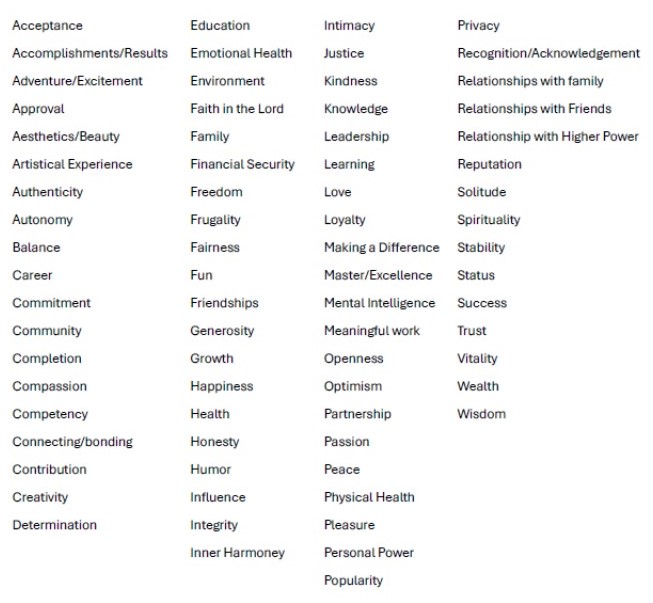
Step 2: Write down the highlighted values that resonated with you.

    Adventure Learning Health Leadership

    Competency Family Financial Stability Meaningful Work

    Curiosity Faith Community Financial Freedom

Step 3: Pick the Five Most Important Values

Step 4: Rank them in order of importance

Step 5: Answer the question: What goals can I pursue or accomplish that will enrich the areas within these values?

Step 6: Set your goals under these five pillars (values)—ensure your goals are S.M.A.R.T.

    An additional step would be to list your key virtues within these five stated values. These are general statements on how to practice these values.

Step 7: Develop Your Life Purpose Statement.

The purpose of my financial resources and my life’s efforts is:

    Example:

    My financial resources and life purpose are to satisfy my curiosity and appetite for learning and discovery while also ensuring my financial stability. I will pursue meaningful work that makes a positive impact on my family, friends, and the community. I will also dedicate my lifestyle and schedule to maximizing my health.

    Example of Values-related Goals (Note: these should have target dates of completion)

Ways that I will bring this purpose to life are:

    Plan our trip to Greece for next year

    Enroll is a bible study course in the first quarter of this year

    Help our children grow, realize self-sufficiency, and pursue happiness. Fill a board position at my favorite charity this year

    Read three books within my areas of interest per quarter

    I will make the following changes to my lifestyle to further improve my health in the first quarter of this year—specifically, _______.

Reinforcing Your Focus on Goal Achievement

    An additional exercise to reinforce these goals and increase the likelihood of achieving them is to review them three times a day.

Develop Your Own Personal Vision and Mission Statements

    Additionally, you can establish an individual or family mission and vision statement.

    A vision statement is your ideal future—it describes who you want to be, what you want to accomplish, and the impact you want to have on the world. Here are some steps to writing a personal Vision statement.

Step 1: Reflect on Your Core Values

Ask yourself:

    What principles guide my decisions? (Integrity, faith, service, creativity, etc.)
    What truly matters to me in life?
    What motivates me to get out of bed each morning?

Step 2: Imagine Your Ideal Future

Picture yourself 5, 10, or even 20 years from now:

    What have I accomplished personally and professionally?
    How do I feel about my life and the impact of my contributions?
    What kind of relationships do I have?
    What legacy do I want to leave behind?

Step 3: Define Your Purpose & Aspirations

Your vision should be bold and inspiring. Consider statements like:

    “I want to inspire and empower people through education.”
    “I envision myself leading a purpose-driven business that makes a positive impact.”
    “I will live a life of faith, integrity, and generosity, serving others daily.”

Step 4: Write Your Statement in the Present Tense

    Your vision should be written as if it is already confirmed, making it more powerful. Example:

    “I am a leader who uplifts and inspires those around me. I create growth opportunities, build strong relationships, and leave a lasting positive impact on the world.

Step 5: Keep It Short & Meaningful

    Aim for one to three sentences that capture your aspirations.

Writing a Personal Mission Statement

    A mission statement defines how you will bring your vision to life daily. It serves as your action plan for fulfilling your purpose.

Steps to Write Your Mission Statement:

Step 1: Identify Your Strengths & Passions

Ask yourself:

    What am I naturally good at?
    What activities bring me joy and fulfillment?
    How do I want to use my talents to serve others?

Step 2: Define Who You Want to Serve

    Who benefits from my work and actions? (Family, community, business, clients, etc.)
    What needs can I meet with my skills and knowledge?

Step 3: Describe How You Will Fulfill Your Purpose

Consider the actions and behaviors that align with your vision. Examples:

    I will utilize my leadership skills to mentor and empower young professionals.
    “I will create meaningful content that educates and inspires others.”
    “I will serve others through kindness, generosity, and faith-based leadership.”

Step 4: Make It Action-Oriented & Clear

    “My mission is to lead with integrity, inspire others to reach their full potential, and continually grow in faith and wisdom.”

    “I strive to build innovative businesses that solve real-world problems while creating a positive impact on my community.”

Step 5: Keep It Concise & Memorable

A strong mission statement is brief (1-2 sentences), actionable, and inspiring.

There is a lot to digest here. However, a great place to start is establishing your values and prioritizing them. From there, establish S.M.A.R.T. goals in each of the values that you want to focus on. It doesn’t have to be all of them; you can focus on a few in the first part of the year, the rest in the second part, and so on.

I recommend that you consider establishing a personal Vision statement and Mission statement because it reinforces why you’re striving for these goals in the first place.

Steven Zeller is a Certified Business Exit Planner, Certified Financial Planner, Accredited Investment Fiduciary, and Co-Founder and President of Zeller Kern Wealth Advisors. He advises business owners with developing exit plans, increasing business value, employee retention, executive bonus plans, etc. He can be reached at szeller@zellerkern.com

Deal Momentum, Deal Fatigue, and Pre-Sale Diligence

 
With the help of her Exit Planning Advisor, Betty has decided that selling to a third-party buyer would best accomplish all of her goals (financial, values-based, legacy).

Quantifying her business and personal resources with a financial gap analysis has been helpful to Betty in determining her departure date in six years. She now knows the current fair market value of her business and how much it will need to increase in value to attain her financial objectives at sale in six years.

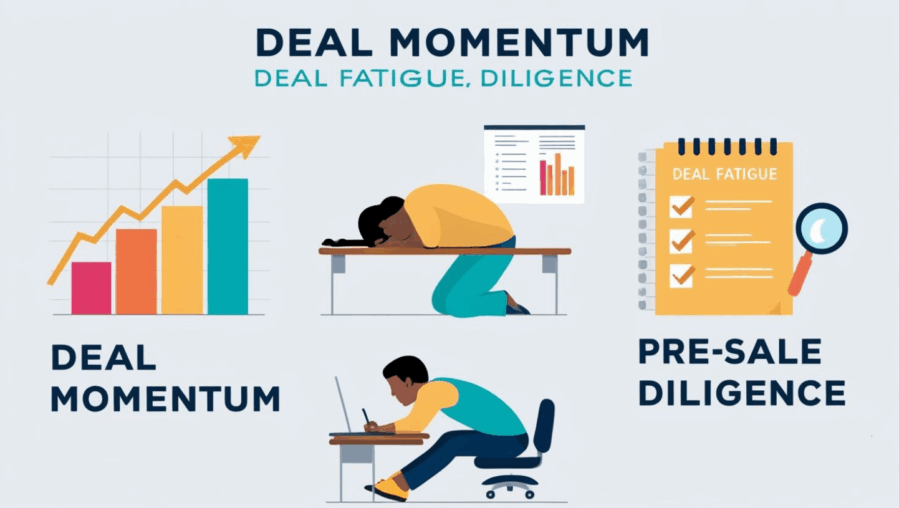
Betty now also understands (again with the help of her Exit Planning Advisor) the importance of maintaining “deal momentum” when she eventually enters into a sale transaction.

Betty now knows that all too often, “deal fatigue” sets in and damages or destroys deal momentum experienced early in the process. She also understands that deal fatigue typically results from a difficult and lengthy due diligence process. Due diligence is defined as the process by which the buyer requests documents, data, and other information about the business they want to review to identify any potential liabilities or hindrances to a deal getting done. The process of due diligence involves setting up a digital “Data Room” where all requested information is deposited for review.

Person at a desk demonstrating: Deal Momentum, Fatigue and Diligence
A key component of Betty’s comprehensive exit plan is to do everything possible to ensure deal momentum and avoid deal fatigue when the time comes.

Betty also wants to be prepared if a serious and qualified buyer comes calling earlier than her six-year time frame. So, with the assistance of her Exit Planning Advisor, she is going to conduct “Pre-Sale Diligence” systematically over the next 12 months, including setting up a virtual data room that she will regularly review and update as needed. This preemptive approach will significantly increase her chances of deal momentum and a smooth transaction experience.

At that point in the future, when Betty is approached by a potential buyer or when she takes her business to market, having conducted Pre-Sale Diligence, she will be better prepared, more confident, and less stressed and anxious—all of which lend toward sustaining deal momentum and a successful transaction.

Pat Ennis is the President of ENNIS Legacy Partners. The mission of ELP is to help business owners build value and exit on their own terms and conditions.

The Power Of Strategic Exit Planning


In today’s business landscape, having a strategic exit plan is not just a luxury—it’s essential. Effective exit planning involves setting clear goals, understanding your business’s value, and creating a detailed roadmap to achieve a smooth transition.

Starting early with your exit plan allows you to set precise objectives and assess your business’s value well in advance. This proactive approach provides the flexibility to adapt to changing market conditions and business performance, ensuring that your exit strategy remains relevant and achievable.

To maximise the return on your business, you must have a thorough understanding of its value. This goes beyond simple financial metrics and includes evaluating intangible assets such as brand equity, customer relationships, and intellectual property. Accurate valuation helps in setting realistic expectations and negotiating effectively with potential buyers.

Power of Strategic Exit PlanningA well-defined roadmap is crucial for guiding the exit process. This plan should detail every step, from preparing your business for sale to identifying potential buyers and managing legal and financial aspects. A structured approach ensures that all aspects of the transition are handled efficiently and with minimal disruption.

Enhancing your business’s value involves focusing on operational improvements, strategic growth, and strengthening your market position. By addressing these areas, you can increase your business’s attractiveness to buyers and achieve a higher sale price.

A smooth transition requires effective communication with all stakeholders, managing the emotional aspects of leaving the business, and providing support to the new owner to ensure continuity. A comprehensive transition plan helps in maintaining the business’s reputation and achieving a successful outcome.

Kerry Boulton, CEPA is Australia’s most respected exit strategy advisor. With over 20 years in business as an entrepreneur, transformative coach, consultant, sought after speaker and talented facilitator, Kerry has been helping business owners like you to overcome challenges while providing the steps needed to ensure that you find the financial freedom you deserve.

What is “Holistic” Planning?

 
Financial planners use the term “holistic planning” frequently. It’s meant to indicate that they consider the client’s short- and long-term life goals and the future they visualize. According to Fidelity Investments Holistic Wealth Planning is continuous and considers two dozen aspects of client wealth objectives.

The Valuation Reality Gap

Only one of those aspects is ownership of a business. This raises the question “If a typical business owner has 50% of their net worth in a business, is it really just 1/24 of their planning?”

Of course not. I’m exaggerating for effect, but there is an uncomfortable truth about financial planning for business owners.

When we ask financial planners about their assumptions regarding business value, the great majority (almost all) reply that they use a value provided to them by the client. Unfortunately, most business advisors estimate that the average owner’s impression of their company’s value is at least 35% too high.

An owner is planning on a $3,000,000 nest egg in retirement. He estimates that $1,500,000 will come from the net proceeds (after paying capital gains tax) of selling his business for $2,000,000.

But 90% of businesses that size are sold on an asset basis. That could bump the tax rate from under 25% to something closer to 40%. If he has overvalued by the “average” of 35%, a $1,300,000 sale would net $780,000.

Holistic Planning Man

Impact on Retirement Goals

Now his nest egg is $720,000 short of goal. Retiring on $2.3 million isn’t exactly poverty, but it would require substantial changes to the anticipated goals.

That is why financial planning for business owners can’t be holistic if it doesn’t include the value of their business. That value should be confirmed by a third party.

Exit planning is the critical final component of a business owner’s wealth strategy. A business requires different tax strategies, risk management and timing assumptions from simply calculating around a pension. Even an appraised value can range widely between different transition strategies.

Holistic Planning in Exit Considerations

How is estate planning affected by the disposal of the business? Does it employ one or more children? Just as importantly, does it not employ one or more children? How can the business value in the estate be balanced between fair and equal? In the most extreme case, will the business be passed down as part of the estate? In that case its value may not be included as part of the owner’s wealth at all.

Will the business be sold to a third party, or as part of a management buyout or ESOP? The proceeds may be realized all at once, or over a long period of time. Is there value for any real estate involved? (A new owner may or may not wish to purchase the real property.)

Holistic planning for a business owner is far more complex than for an employed individual. It’s almost like having a second client in the room. If the planning doesn’t consider the myriad of complexities surrounding monetization of an illiquid asset (the company), it may not be considering the biggest single factor in the client’s financial future.

John F. Dini develops transition and succession strategies that allow business owners to exit their companies on their own schedule, with the proceeds they seek and complete control over the process. He takes a coaching approach to client engagements, focusing on helping owners of companies with $1M to $250M in revenue achieve both their desired lifestyles and legacies.

Build a Successful Business Exit Plan by Using a Planning Process

 
As a business owner, planning the exit from ownership of your business is probably the single most important decision you will make. When to exit, how much to walk away with, who to sell it to, what’s the most tax efficient strategy in your circumstance, what timeline is most suitable, and what are the areas of business that need to be improved upon to make it marketable, etc.? Those are just some of the things that need to be considered.

The challenge for many business owners is they don’t want to think about it until they’re absolutely ready to exit. The problem with that is, you won’t know when that will be, and it may happen unexpectedly, due to health and so forth. Furthermore, and especially with “baby boomer” owners, their business is everything to them – They don’t want to think about letting go, so they put it off. Plus, even if they do sell, what are they going to do when running their business isn’t with them every day. – What’s going to be their purpose when that comes to an end? So, they put it off, and when they decide to exit, the business may be unprepared to sell, the market may not be favorable, or they won’t get the price that they thought they would.

All of what I just mentioned, can be addressed or avoided with the proper business exit plan. A proper business exit plan should be done by applying an organized process. It is also important to remember that building a solid exit plan takes time. It’s nothing that you simply flip a switch, and presto, you have a solid exit plan. There are many things to consider, advisors you need to bring in the mix, data that needs to be collected, and analysis that needs to be performed.

Over the years in consulting my business owner clients, I have developed a “business exit planning process.” The diagram below is an illustration of that process. It breaks the process into three separate phases: “Create A Game Plan”, “Plan Development”, and “Implementation.”
 

The “Create a Game Plan” phase is the initial phase of the exit planning process. This includes completing an exit plan assessment, which determines what areas you will need to address in order of priority, determining your vision for the future (after you have exited), how much you will need to walk away with, whether to sell to a third party or an insider, performing a preliminary valuation, and assembling your team of advisors.

For performing an exit plan assessment, I use a tool called “ExitMap”, which is a handy tool and takes the client 15 to 20 minutes to complete. Determining your vision for your future, is a discussion of the owner’s life after the business. That is an important discussion and may be a transition that needs to be planned for over a period of time. “Letting go” doesn’t come easy for some business owners. In fact, there are even tests now that can help determine how you will handle it when that time comes, and what to do about it. There is a consultant firm in Southern California, by the name of “Orange Kiwi” that specializes in that type of consulting. Determining how much you need to “walk away with”, involves analyzing how much you will need to live your life after the business and the goals you want to accomplish that require financial resources, and how much you have accumulated outside of the business. This will determine the dollar amount that you will need to walk away with, from the business. This is then compared to the preliminary valuation which reveals the “gap”. For instance, if you need to walk away with $3 – $5 million net after expenses and taxes, and your business is currently worth approximately $2 million, then the “gap” is $1 million to $3 million.

This leads us to performing a “preliminary valuation”, which is an informal valuation and costs a fraction of a formal valuation. It is a necessary step in order to determine where you stand and how much of a financial gap exists. Finally, the last step in this phase, is forming your team of advisors. Exit planning is a team sport, and you need the right people/advisors on your team – Professionals who are experienced and who are willing to work together. The diagram below shows a number of potential advisors, an owner may need a few of them or many of them at different times.


The “Plan Development” phase includes the gathering of data, the development of a draft plan, the development of a final draft plan, and establishing a plan of action which includes setting time tables, delegating tasks to advisors, and so forth. When we gather data, there are many areas to gather from. This includes the financials, performing a 5-year cash flow analysis, a 5-year cash flow projection and a host of other metrics, client base analysis, re- occurring income, etc. The draft plan is a starting point of a plan. It is reviewed by all of the participating advisors, which may include the C.P.A., the business broker or investment banker, the out-sourced C.F.O., estate planning attorney, tax attorney or business attorney, and so on. Depending on your particular situation, some or many of these advisors may be included.

The “Implementation phase” of the planning process includes “managing the action steps”, and revising the plan as needed, performing a formal business valuation (one that holds up in the negotiation of the sale), positioning the company for sale or inside transition, and the liquidity event, or the actual sale.

Managing the action steps is critical, because plan execution is critical. It’s one thing to develop a plan, but implementing it properly is crucial in a successful outcome. The exit planning professional can help an owner with that, so that he or she does not get consumed by it and can continue to work on the business. Performing a final valuation is required, which is a solid valuation to include in the sale of the company and also for tax purposes. Positioning the company for sale is where a business broker or a merger & acquisition professional comes in. They are the ones who will position the company for sale, put the company to market, and help to finalize a sale. It’s better if they are included earlier on.

It is also where the implementation of structuring the company ownership comes in. Meaning, what is the best way to position the ownership of the company to achieve the most tax efficient transaction. For instance, utilizing special trusts that avoid state taxes upon the sale of the company. But, that is for a future discussion.

Then comes the liquidity event or the actual sale of the business. It often doesn’t come easy and negotiating with a third party can be grueling and time consuming. But the better you have planned and prepared, the better the outcomes will most likely be.

My intention of this article is to point out a few things: One, the best way to develop an exit plan is by applying a process. Two, exit planning takes time. Three, exit planning is a team sport and requires the careful selection of advisors. And four, exit planning is a serious subject and requires a thorough discussion – more than a discussion with your local C.P.A., although a C.P.A. is a critical advisor in the exit planning process.

Steven Zeller is a Certified Business Exit Planner, Certified Financial Planner, Accredited Investment Fiduciary, and Co-Founder and President of Zeller Kern Wealth Advisors. He advises business owners with developing exit plans, increasing business value, employee retention, executive bonus plans, etc. He can be reached at szeller@zellerkern.com