Exit Planning Tools for Business Owners

The Gen X Business Buyer

Generation X’ers aren’t mini-Boomers. Raised in a rapidly growing economy by parents that approached child rearing as a competitive activity, they saw more, did more, and were given more than their parents could have dreamed of.

I took my first commercial airline ride when I was 25 years old (and before my mother’s first flight). My two sons had each boarded planes over 50 times before they were in high school.

I was not an athlete, and have no hardware to display testifying to any athletic prowess. My youngest son made varsity in one sport, for one year. Yet he has a bookcase full of trophies.

I received a couple of piano lessons from a neighbor who played. My children had paid instructors for martial arts, gymnastics, baseball, piano, viola, singing, and math. They are far from the most-coached kids I know.

The challenge of selling a business to a small and disinclined group of prospective buyers starts with their lack of numbers, but it is just as much about how they were raised by their Boomer parents. Generation X has different values and many more choices.

Values

The numbers are just the most obvious (and the most inevitable) factor impacting Generation X as buyers. The second factor is values. Every Boomer owner I know, and there are hundreds, has complained about the expectations and the lack of a decent work ethic among Generation X. This isn’t caused by a special laziness gene. It is a matter of values.

Boomer “super parents,” driven by their competitive  approach to everything, raised children who expected to be accepted for who they are, and to have things done for them. Boomers created the children’s ball team where everyone got a trophy just for participating, regardless of the team’s success. X’ers watched their parents struggle with a breakneck pace and the concept of work-life balance and, like every generation of offspring, saw their parents’ approach to life as stupid.

So Generation X, by and large, doesn’t equate material comfort directly with work. Their “balance” is oriented towards separating work and life. Unlike most Boomers, who live to work, the X generation only works to live. Work isn’t their identity, it is merely the thing that permits them to finance what they really want to be.

For Boomer entrepreneurs, who accept a 50 or 60 hour work week as simply part of the cost of business ownership, that isn’t good news. The next generation of buyers doesn’t agree with you, and isn’t interested in subordinating their lives to the quest for success.

Choices

I know five local CPA firms that have sold to regional or national competitors in the last 3 years or so. Each had the same problem. They had built a model where the retirement of the Boomer founders was dependent on the profits to be generated by the next generation of partners. Unfortunately, that generation wasn’t interested in assuming the required work load. In several of the cases, a younger partner was invited to a meeting, where the senior partners announced that he or she had been selected as the next leader of the firm. To their shock, the annointee turned them down flat.

Corporate America is aware of the coming shortage of educated, hard-working, middle-aged executives. They are recruiting them with far greater benefits and perquisites than a small business can afford.

Since the 1970’s, a flood of regulation and increasing liability connected to business ownership makes the entrepreneurial proposition riskier and more tedious. The Boomers have only themselves to thank for that.

The retirement of the Boomers is placing a crushing burden on Medicare, Social Security and pension funds. The likelihood of greater taxation, and lower benefits for those who follow, detracts from the attraction of working hard to make a lot more money.

Finally, technology has vastly expanded Gen X’s choices. Flex time, telecommuting, job sharing, family leave and home-based businesses make the traditional model of sitting in a business all day look far less appealing.

The bleakest future is for a small business that has few factors, other than the owner’s personal reputation, to differentiate it from its competitors. It depends on the ongoing efforts of its owner to produce revenue. It has a number of employees who are only trained on the job, or who possess few distinctive skills that make them an integrated part of the business. It has no incentives that lock the best performers into long term relationships.  It lacks middle management, or anyone who can run the business indefinitely without the owner around to make decisions.

If that describes the business you own, it is time to start making changes. The generation that is reaching business-buying age has more choices for earning a living, and many more choices that better fit their values.

This series is focused on Boomers who are preparing to exit their businesses. For owners who precede the Boomers (currently in their 70’s), there is still a market of younger Boomers (in their late 40s and early 50s) to sell to. We are describing a problem that is only going to accelerate in the next 5 years. It is unavoidable, and the numbers are irrefutable.

There is some good news. You can do something about it. Most small business owners will remain oblivious to the realities of the market until they try to sell, and even then probably won’t understand the reasons why they can’t.

Like the hiker running from the bear, you don’t have to be faster than the bear. You just need to be faster than the other hiker. Simply reading this puts you ahead of the pack. We next turn our attention to what it will take to successfully exit your business in the toughest selling market in history.

Picture Credit

(This is the seventh installment in a series about “Beating the Boomer Bust.” Previous installments are The Approaching Tidal Wave, The Pig in the Python,  The Brass RingWork-Life Balance, Outsourcing America and The X Factor.)
 

The X Factor

There are two sides to every business transaction, a buyer and a seller. For most of the last 50 years in America, the Baby Boomers have been the biggest buyers in history. They bought homes and cars to spur the economy after World War II. They bought franchises to provide services for each other as busy parents. They bought SUVs and McMansions when they became the affluent middle-aged.

Squeezed out of a corporate America that didn’t have room for them, and couldn’t offer the clear path to success they had been raised to expect, the Boomers formed new businesses in numbers unmatched before or since.

In 1975, when the first Boomers turned 30 years old, there were 300,000 new business formations in the United States. By 1986 when those same Boomers were 41, we saw almost 750,000 new businesses open, a number 250% larger than just 10 years before.

Just as importantly, by 1990 the rate of new business openings had dropped back to 600,000. It has remained at roughly 600,000 ever since, despite that fact that the national population has grown by almost 65,000,000 people since then (from 249 million in 1990 to over 313 million in 2010).

Boomers didn’t just open a lot of businesses because of their sheer numbers, although that was part of it. They opened them because the had been raised with greater expectations than previous generations. Their values focused on material evidence of success, combined with a powerful attachment to a workplace persona. Subsequent generations have not embraced business ownership like the Boomers did.

But in 2010 the first Boomers began turning 65, and a generation that has driven the American economy by buying feverishly is about to turn into sellers. It won’t happen all at once. Improved health care, technology, their value on work roles and a fairly dismal record of saving will all combine to keep the Boomers in the workplace longer than their parents. But sell they will, and soon they will be bringing a massive wave of small businesses to market.

The buyers are Generation X, the youngest of whom were just turning 25 years old as the first Boomers hit 65. Generation X as a term has been used in various ways as early as 1964 to describe disaffected adolescents, to describe all 20-somethings, and to specifically cover those born between 1960 and 1965 (note that several of these uses are actually about Boomers). My preferred definition is the tenth generation since 1776 born as citizens of the United States (Roman Numeral X).

This generation, beginning with the babies of 1965 and continuing through 1984, is a big problem for Boomers who are preparing to sell their businesses. The issues are three-fold: numbers, values and choices.

We will first discuss the numbers, since they are the most powerful argument for what is to come. We cannot change the birthrates of 40, 50 or 60 years ago. All the people who were born between 1945 and 1964 are born. There will not be any less of them. Those born between 1965 and 1984 are the same, there won’t be any more.

This is a deep dive into the statistics. It may be a bit tedious for some folks, but it is critical to understanding the scope and impact of the problem.

Numbers

Even on the face of it, the numbers aren’t favorable for the Boomers who will be selling their companies. The X’ers number about 69 million in total, around 9 million, or 11%, fewer than the Boomers. That may not sound like a lot, but think about how profitable your business would be with 11% fewer sales.

Eleven percent of any market is a chunk. If your market is the entire United States of today, taking 11% off the table would mean removing Indiana, Massachusetts, Michigan, Wyoming and Virginia. Those aren’t minor markets. (Well, maybe Wyoming, but I needed to make the numbers come out.)

Most markets aren’t the entire country, however. Starting with the Boomers as children, Marketers have increasingly segmented and targeted age groups for their products. Shrinking a target market by 11% means fewer prospects to sell to, and small businesses for sale will simply have fewer prospective buyers.

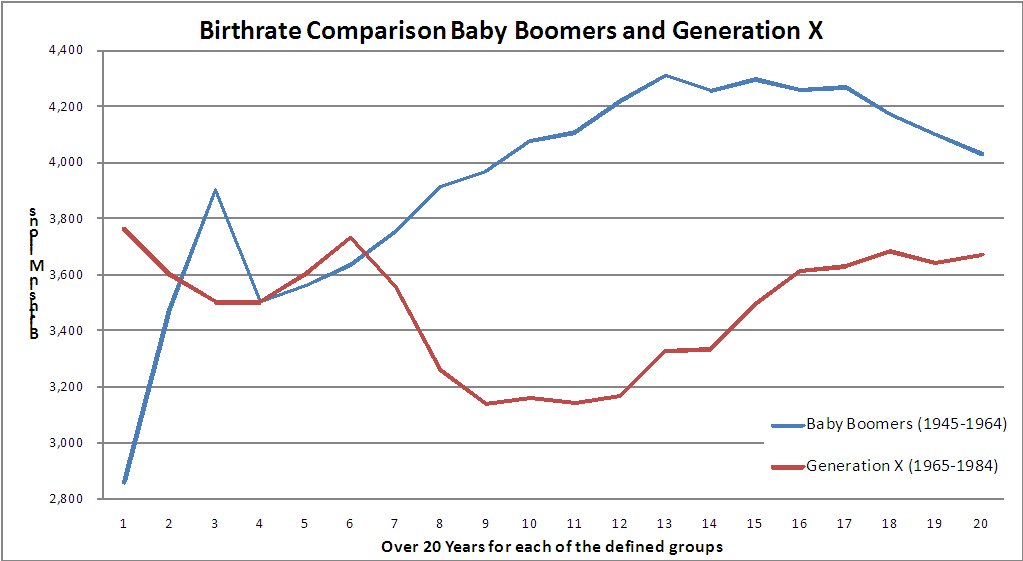
The impact is even more dramatic when the curve of births is examined. Boomer births peaked in 1957 at 4.3 million. Gen X births declined steadily from 1965 through 1973, when only 3.1 million, babies, 28% fewer than in the peak Boomer year, were born. For the period from 1953 through 1957 almost 21 million Boomers were born. For 1973 through 1977 there were just under 16 million new X’ers.

That means from 2018 through 2022, when those babies hit 65 years old, almost 5 million fewer people (23%) will be turning 45, and entering their prime business buying years. What would your market look like with 23% fewer buyers? What happens to pricing and competition when you start with 3 buyers for every 4 sellers?

We are rapidly approaching the worst imbalance between small business sellers and buyers in history, and it will continue for the next 20 years.

If the problem was limited to the numbers alone it would still be dramatic. In addition, there are other factors that make the numerical shortfall even more pronounced. The profile of the buyers, the values and the choices of Generation X,  will exponentially increase the gap between Boomer sellers and the people to whom they expect to sell their businesses.

(This is the sixth installment in a series about “Beating the Boomer Bust.” Previous installments are The Approaching Tidal Wave, The Pig in the Python,  The Brass RingWork-Life Balance and Outsourcing America.)

The (pen)Ultimate Hire

Every sane business owner will acknowledge that there is a point at which his or her own skills are no longer sufficient to grow the business beyond its current level. The revenue point where that happens differs by industry, but it frequently begins at around 20 employees.

At that point, an owner becomes swamped by the conflicting needs of managing the existing operation, and having enough time to perform the tasks that made the business grow in the first place.

The owner realizes that further growth requires the addition of a key employee; one who can assume some of the owner’s duties so that he or she can focus on organizational development.

The typical plaint in this situation is “I need someone who can think. An employee who can run things without my daily input, so that I can focus on what I do best.”

But there is another version that is materially different, although it sounds the same on the surface. “I need someone who can run this company without me.” is a far cry from one who can handle day-to-day operating responsibilities.

Many owners fail to look beyond the immediate need for task relief  to determine exactly what this key employee’s long-term role will be. There is a big difference between hiring an SIC (Second In Command) and an SIT (Successor in Training.)

A Second In Command is responsible for assuming some of the owner’s ongoing decision-making and management duties. The SIC’s role is to free the owner to do what he or she is best at (or enjoys the most). The job description is based on the assumption that the owner is present, or at least available, to check off on major decisions and give ongoing guidance.

In my presentation to business owners, “Beating the Boomer Bust” I discuss the likelihood that many owners will have to execute their own succession plan by growing a successor internally. This Successor In Training is more than someone who can merely back fill your skill set. It needs to be someone who can eventually replace your skills in the business.

The common wisdom is that an SIC should compliment, not duplicate, your talents. We advise owners not to hire a “mini-me,” since it is unlikely that you can find someone who has the same motivations to cover all the various skills that ownership requires.

Typically, you take your job description (finance, sales, business development, culture, motivation, operations, marketing, management) and subtract those things that you want to continue doing personally. The rest of the duties become the SIC’s job description.

But the intention of many owners is to develop the SIC into an SIT. An SIT is someone who can eventually assume all of your higher-level duties. He or she has to create value while you are still there by filling in the gaps in your skill set, but must also have the potential to grow into a broader role as you prepare to withdraw from the business.

Of course, you are still in for a long search if you seek a “mini-me.” The likelihood is that your SIT will eventually need an SIC of his or her own. If you can’t run the company by yourself, your successor can’t either. If you need an SIC now who pays closer attention to the numbers and ratios than you do, then that person will eventually need someone to focus on sales and development.

Hiring a key executive is the single most important decision you will make. Don’t begin the process by making the mistake of looking at only the needs you have today. A solid SIC will probably take five years to fully integrate with you. An SIT may take ten. The investment can be wasted if you look only at your immediate needs. Start with a longer-term vision of how you want your role as an owner (or as an ex-owner) to play out.

Another Lost Generation?

I had the opportunity to present “Beating the Boomer Bust” twice this week, one of which was recorded for a Texas Public Radio show this weekend. For those who aren’t familiar with the piece, it discusses the massive changes that are unfolding as Boomers retire from their businesses.

As usual, members of the audience said afterwards “I knew all those things, but I never thought through the implications before.”

A quick recap before I get into today’s topic. “Beating the Boomer Bust” is a look at the perfect storm facing retiring owners who plan to sell their businesses. That largest small-business-owning group in history will be selling all at the same time. The number of buyers is about half as large as the number of sellers, and the buyer generation (Gen X) isn’t interested in the type of work that small business entails.

It is that group, the buying generation, that could be facing a demographic squeeze that changes them into a new “lost” generation.

The first Lost Generation is the group born in the decades just before the beginning of the 20th century. The oldest members of that group were in their teens and 20’s during WWI, which decimated the ranks of the young men, although less so in the USA than in Europe. Those who returned were traumatized, and more worried about enjoying life than making their mark on the world.

Enter the Roaring 20’s. The Lost Generation writers, Gertrude Stein, Ernest Hemingway, F. Scott Fitzgerald and T.S Eliot among others, promoted both hedonistic lifestyles and a cynical outlook towards humanity. The 20’s generally bring to mind Flappers, Speakeasies, Gangsters, and a spectacular finish with the Great Depression of 1929.

Many generations have been characterized as wastrels when they are young. The Lost Generation had the added misfortune to reach their productive years, their 30’s and 40’s, just as the economy made it very, very difficult to get ahead. Now, let’s skip forward to Generation X.

What Boomer hasn’t complained about the work ethic of Gen X? Gen X was born and raised in a time of plenty. They have grown up in an economy that was fueled by a giant generation of workaholics, the Baby Boomers. Their values system places a far lower premium on business and financial accomplishment. Self-actualization comes first, accumulating things is secondary.

Disclaimer: Please don’t send comments about “I’m a Boomer and not a workaholic” or “I’m an X’er and work very hard.” No generational generalizations are universally applicable. I get it.

Now they have the added misfortune of being in their 30’s and 40’s when the economy isn’t very receptive to building wealth or rapidly expanding a business.

At first blush, I didn’t think that was a problem. With one X’er for every two retiring Boomers, there should be more than enough opportunity for even the marginally interested to succeed. The more I think about it, the more I begin to wonder whether that will be the case. Two other factors are coming into play, and both are huge.

The Boomers aren’t getting out of the way, and the Millennials are coming on fast.

Boomers haven’t saved enough to retire in comfort. They can’t depend on the government to make it up for them. They are healthier than any previous generation. If 60 is the new 40, why would they (outside of the public sector) suddenly step down at 65? They want to be busy, and they want to be wealthy. Many, if not most, are planning to spend at least a few additional years in that pursuit.

The Millennials (depending on who you ask, roughly the generation born between 1985 and 2005) are coming of age in a difficult environment. Jobs are scarce, finances are lean, and the position of America in the world is changing. All indications are that the Millennials will push harder than the X’ers to get what they want.

Where the X’ers are widely characterized by their sense of entitlement, the Millennials clearly expect their lifestyles to be a direct outcome of their success in work.

So this is what leads me to ask about a Lost Generation.

The Big Picture: 78 million Boomers, still working hard, and delaying their exit from the business arena. 38 million Gen X’ers, with high expectations and lower motivation. 80 million Millennials coming on fast and intent on competing for what they want.

The Small Picture: X’er in his late 40’s who has spent the last 20 years in business telling the employer how he wants his job to fit his lifestyle. He is waiting for a late 60ish Boomer in front of him to get out of the way. When it finally happens, he suddenly finds that there is a Millennial in his late 20’s who earns less and works more waiting to leapfrog him.

If you are a Boomer business owner who can’t find the next generation of leadership among your X’ers (and there are millions of you), start looking at your Millennials while you still have some time to train them.


Painting: Han Wu Shen “Young Worker” at paintinghere )

Three Circles of Family Business

What is a “Family Business?” A large percentage of small companies have some family involved. For most, it is simple a case of providing employment to family members. If the founder of the company is also the principle revenue generator, it may be a spouse (most often the wife) who keeps the books and runs the office.

Employment of children who can’t (or won’t) find another job is common, and more so in the current economy. In most instances it is just a matter of income transfer with some value attached. The owner could keep handing over money for the child’s living expenses, but he or she wants the offspring to “earn” that money. The business becomes a vehicle for parenting; teaching life lessons about responsibility. In fewer cases, it is a recruiting tool. The owner tries to get the child interested and involved in the business, with hopes that they will seize the opportunity to become part of a succession strategy.

There are scores of variants, such as the absentee family employee who is really just a charity case. Performing no duties, and frequently not even in the same geography of the business, employment is simply a mechanism for the owner to make tax-deductible contributions for someone’s support.

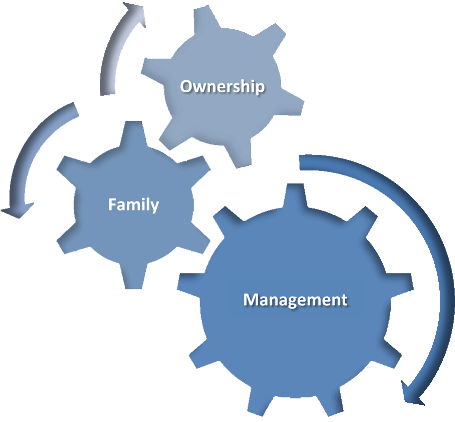
The three circles of this title refer to when the engagement of multiple family members in the business involves a blood (or marriage) relationship, participation in management decisions, and ownership. For our purposes, all three must be present in order for it to be a “Family Business.”

When all three factors are present, they set up a structural conflict that is challenging to deal with. Issac Newton postulated laws governing mass and attraction; the effect one body has on another in relation to its size. The problem with Newton’s laws is that they apply to two, and only two, bodies acting on each other. When there are three bodies of mass the laws become chaotic, since each change in one body not only alters its effect on the others, but immediately alters their effect on each other.

So it is with the laws governing family business relationships. When there are only two roles, effects are fairly predictable. One role, of course, is always the kinship between the parties. If only one of the family members has ownership, the roles in the workplace are pretty plain. If other family members have ownership, but don’t work in the company, their input can be anticipated and occurs within defined parameters. When family members hold two roles in the business, both employee/manager and ownership, each action in one area causes unequal and unpredictable reactions in the others.

In one business, a brother and sister were sold ownership, but until the parents were paid, the siblings remained dependent on their paychecks for normal living expenses. The brother worked long hours, kept a careful eye on expenses, and ran a “tight ship” when it came to employee issues. The sister came in late, left early, and was fond of showing employer largess by issuing unplanned raises to favorite workers. Her sibling and ownership relationships made it difficult to deal with her radically different management style. She felt that she had an equal “right” to run the company as she wished, even if it was the polar opposite of her brother’s style.

In this case, the brother’s solution was to force his sister to sell her stock, and continue to give her a salary conditioned on her no longer coming to the office. The company is better off, but they don’t speak to each other any more.

In another, a brother’s division of the family business underperformed those of his siblings. Eventually he left to work in another company, although he retains his ownership and they still get together for holidays.

The pressure of decision-making and implementation in a family business adds complexity to every situation. Is Dad overriding our opinions because of his greater experience and wisdom, or is it because he regards any dissent from his children as disrespect? Is Mom against the new initiative because she really judges the market to be weak, or is it just her natural inclination to protect what we already have? Has my brother really studied that opportunity, or is he just trying to do something on his own, without his big brother’s shadow over it?

Family members know each other too well to ever make a completely unbiased analysis. The best you can do is recognize the three circles that influence every action, and discuss the mass and attraction of each one when making decisions.