Exit Planning Tools for Business Owners

Outsourcing America

The Baby Boomers created seismic shifts in American culture and economics throughout their lives. Their mere numbers caused much of the shift, but their competitiveness and commonality enhanced the impact at every stage of their lives.

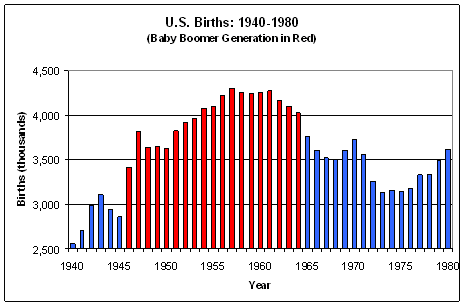
In the mid 1960’s, as we’ve seen, the Boomers delayed having children. Unlike every previous generation, they chose to work longer and accumulate, or at least spend more, wealth. The “trough” of birthrates was lowest between about 1968 and 1978. By the early 1980’s, the Boomers began their delayed child-bearing in earnest.

As the parents of Generation X, the Boomers didn’t suddenly abandon their defining characteristics. They became competitive parents. Parenting became a performing art. Peer pressure made competitive parenting into a status symbol. They set out on the quest for ultimate child development.

The Boomers had two ways possible to approach perfect parenting. The first way requires a huge commitment of time. Mom stays home, and Dad is home as much as humanly possible. You pour your time into giving attention to your children. You engage them in all household activities, such as gardening and cooking. You do their homework with them, and teach them how to play sports. You practice with them, and dedicate evenings and weekends to their development.

That road to perfect parenting doesn’t leave much space for dual career households seeking the upper reaches of the socio-economic ladder. You can’t work lots of overtime, bring work home, play golf with customers on weekends, or go out for career-enhancing social events if you are spending every spare minute delivering instruction and experience to your children.

As a smart, educated, and efficient parent the solution is obvious. You outsource all that stuff. Outsourcing traditional parenting chores served a dual purpose. It saved time for Boomer parents who were focused on career-building, and it created business opportunities for those who couldn’t, or wouldn’t, compete in  climbing the traditional career ladder of corporate America.

Business model franchising was first established in the 1940’s, beginning with businesses that offered prepared food to replace home-made meals. From 1975 (when the first Boomers turned 30) through 1986 the number of franchises sold in the US skyrocketed from about 2,000 to 22,000 annually. That number leveled off in 1986, and remains roughly constant through today.

Competitive Boomer parents had an answer to their time constraints; one that still suited the drive to give their children the best of everything. Little League became merely the first step in sports development. If you were serious about supporting your child’s sporting prowess, you paid for year-round leagues, traveling teams and private coaches. The same logic justified martial arts classes, music teachers and tutors for school subjects.

At home, busy parent could “buy” time by outsourcing not only cooking, but house cleaning, laundry, yard maintenance and repairs. “Do it yourself” faded as a point of pride, replaced by hiring an expert to do it better.

The explosion of franchising was fueled by the rising tide of Boomers serving Boomers. They provided both the service providers and the consumers who paid for those services. By the 1980’s, the portion of the US Gross Domestic Product from services had risen to over 70%.

For franchisors and their franchisees, the model fit Boomer ambitions beautifully. Once established, franchisors had a ready market of hard-working ownership prospects. Many, and probably most franchises are driven by the personal efforts of the franchisee. He or she often opens the business, closes it, and delivers or supervises the delivery of most of the services.

Franchisors are relieved of the expensive, time-consuming roles of motivating employees and managing the day-to-day operations. They don’t need to set sales goals or create growth incentives; Boomer owners do that all by themselves.

What happens when franchisors run out of middle-aged Boomers to buy and drive their growth? The youngest Boomers are now entering their 50s, and are no longer prime candidates for start-up ventures. The oldest Boomers are rapidly (at a rate of 1,000 every 8 minutes) moving out of their peak outsourcing consumption years.

On August 6, 2011, Standard and Poors Sovereign Credit Rating Unit downgraded America’s debt rating from AAA to AA+. The next day the head of the unit, David T. Beers, was asked in an interview to estimate when the top rating might be restored. He replied, “What Americans have to understand is that this country reached its demographic peak ten years ago.

“Awake at 2 o’clock is a weekly column for business owners. This series has been examining the impact of the Baby Boom generation on cultural shifts and the economy of the United States, in order to build the base for the rest of the discussion to come.

What will happen to the millions of Boomer-owned businesses when it is time to hand them off to a generation that is smaller, has very different values, and has far more options? Our next column will begin examining those buyers- Generation X.

(This is the fifth installment in a series about “Beating the Boomer Bust.” Previous installments are The Approaching Tidal Wave, The Pig in the Python,  The Brass Ring and Work-Life Balance.)
 

Work-Life Balance

The term “Work-Life Balance” is widely cited as first occurring in the United State in 1986 in a research paper. I can’t identify the specific source of this much-referred usage, but it is telling that it would pop up when the last Baby Boomers had just turned 21. They were all in the labor pool, and their competitiveness (see The Brass Ring) was rapidly becoming the norm in the workplace.

In the period beginning in 1912, the Federal Government began passing legislation to limit the number of hours that could be demanded of a worker. With the passage of the Fair Labor Standards Act of 1938, the concept of a 40 hour work week was enshrined in national labor regulations.

In the decades following WWII, the average work week hovered between 39 and 41 hours. As the Boomers assumed their dominant role in the workforce, however, it began to climb for the first time since prior to the Great Depression, and by the mid 1990’s was in excess of 47 hours a week for the entire working population. The race was on!

Just as it doesn’t take an economist to understand why a having lot more people creates additional demand, so it doesn’t take a PhD to explain why working more produces more. Combine a generation that was 50% larger than its predecessor, and have that much larger labor force work 20% more, and you have a rising tide that has carried the US economy through today.

But even those factors don’t fully explain the force that was the Baby Boomers. Driven to succeed, they sought new ways to increase household income. One of those became obvious. As the university system opened up to women, educated and ambitious Boomer moms were pressed into service as wage earners. The two income family became the new norm.

Between 1970 and 1980, while the US population increased by 11%, the workforce grew by an astonishing 29%!

“Work-Life Balance” wasn’t a term before the Boomers, simply because it wasn’t a widespread issue before the Boomers. The returning WWII GIs didn’t wrestle with the dividing line between work and life. There was work, and then there was life. You left the office at 5:00 (or the plant when your shift ended) and came home to your life. In the idealized middle-class family, Mom had spent the day caring for the children and preparing dinner. Weekends were for outings and backyard time with friends (in your new subdivision home).

Boomers abandoned that model by the millions. Although the wife still assumed the bulk of the duties of child care and food preparation (and does today), she had to fit it in around a work week spent supporting a lifestyle of success.

In 1984 (when the Boomers ranged from 20-40 years old- prime child-bearing time) Chrysler Corporation introduced one of the greatest product successes of the decade; the minivan. Built on a car chassis (so women could drive it more easily) it had the first feature that acknowledged automobiles as something other than transportation- cupholders!

Now families had transport that accommodated their need to feed children in between school and activities and home. McDonald’s installed its first drive-through window in 1975 (the oldest Boomers had just turned 30). Mom became an efficiency machine, going from work to school to soccer without ever getting out from behind the steering wheel.

In a foreshadowing of what happened to many products that depended on Boomers to support them, over 1 million minivans were sold in America in 2005, when the youngest Boomers turned 40. By 2008, just three years later, minivan sales had dropped by 80%, to just over 200,000. The Boomers were now in their 40s and 50s. More affluent, they could afford to move up en masse to SUVs. (Everyone had cupholders by then.)

The Boomers had reshaped society, first as children, again as working adults, and now as parents. This reshaping went much further that simple productivity. In their quest for identity through work and material success, the Boomers were about to engineer the biggest change of all.

Since 1776, with a small drop during the Great Depression, every generation of Americans has begun promptly producing a new, larger generation upon turning 20 years old. The Boomers broke that mold. Their need for higher education and early focus on potential careers delayed their marriages and child-bearing by years. Once they began having children, the challenges of juggling job and family, along with medical advancements in birth control, led them to have fewer children than their parents did.

As a result, the tenth generation born as United States citizens (known by their Roman numeral as “Generation X”)  was smaller than the Boomers that preceded them by almost 10,000,000 lives.

By now, you have had enough indoctrination regarding the economic effects of rising and falling populations to understand the implications of a shrinking work force. It is no coincidence that the suffering economies of Europe, Greece, Italy, Spain and Portugal, have had the four lowest birth rates in Europe for the last 30 years. Fewer workers are simply bad for an economy.

But Generation X will impact retiring Boomers through more than just numbers. They grew up in minivans, watching their parents work longer and harder in pursuit of success. They aren’t impressed by the results, and are returning to values that separate work from life.

That may be good for them, but it isn’t promising for Boomer business owners on many different levels.

(This is the fourth installment in a series about “Beating the Boomer Bust.” Previous installments are The Approaching Tidal Wave, The Pig in the Python and The Brass Ring.)


The Brass Ring

A long, long time ago (I’ve actually ridden only one such in my lifetime) Carousels had a spring-loaded sleeve of brass rings protruding near the innermost (and least popular) track of horses. A bigger kid could lean out and yank a ring from the sleeve with considerable effort, and be rewarded with a free ride.

Today, of course, we can’t even read the description of such an ill-conceived device without cringing at the thoughts of fallen children, their bodies horrifically mangled in the giant gears of the turntable, and the litigation and public outrage that would follow. Times change.

“Reaching for the brass ring” has become a metaphor for chasing success. As I discussed in last week’s column, the massive number of Baby Boomers would have affected the economy regardless of their other tendencies, but their commonality and competitiveness raised that impact by an order of magnitude.

If you are a Boomer business owner, I defy you to say that you’ve never complained about the work ethic of the younger generation. From the mid 70’s to the mid 90’s (prime time for Boomers in the workforce) American white-collar workers saw the rise of an average work week from just over 40 hours to almost 54. This while our European contemporaries were  campaigning for (and winning) 35 hour weeks and ten weeks of vacation. What made American Boomers so competitive?

Our numbers. There were simply too many of us to accommodate at every stage of our lives. Just as the impact of ageing Boomers leaving the workforce will come as a surprise to most, so the flood of people into schools, homes and jobs took the majority of businesses (and governments) by surprise.

I attended public schools in the 1950’s where 45 or 50 children were the norm in a classroom. It had nothing to do with unenlightened teaching methods or weaker unions. There simply weren’t enough classrooms. Between 1945 and 1957 the annual number of new births in the country increased by 53%, from 2.8 million to 4.3 million. They couldn’t build schools fast enough.

When I started college in the late 1960’s, they were pulling trailers into muddy fields and calling them community colleges. There weren’t enough universities for all those who wanted to attend. And when I graduated and applied for a position in corporate America, their hiring offices were like the Department of Motor Vehicles, with group testing and rows of interviewing offices.

It was a time of plenty in America, but there wasn’t enough of what the Boomers were seeking. The “Spock Babies,” as we were called, had been raised to believe that every one of us could, and should, succeed. We all expected the corner executive office, but there weren’t enough places for everyone.

(An aside: I’ve always been curious about Gene Roddenberry’s selection of a name for the First Officer of the Starship Enterprise. Was there some subliminal appeal that helped make Star Trek one of the most popular Boomer shows in history?)

From 1966, when the first Boomers turned 21, through 1975, the rate of college graduations in the United States tripled on an annual basis, from just over 600,000 to nearly 1,700,000 a year. (See the timeline at The Boomer Bust)

Baby Boomers competed for the better places in schools and for admission into the better universities; and then competed fiercely for jobs when they graduated. Once employed, they were part of a glut of other qualified Boomers; roughly the same age, and with similar qualifications. The brass ring went to the ones that worked hardest, longest and smartest. An entire generation accepted competition as a way of life. It was a numerical inevitability.

But many Boomers were squeezed out by the numbers, or were disinclined to engage in a battle for promotions and raises. They still wanted the gratification that Dr. Spock said they should have. They still expected the brass ring.

They went into business for themselves.

From 1975, when the first Boomers turned 30, until 1986, the formation of new businesses in America jumped from 300,000 to 700,000 annually. By 1990, when the oldest Boomers turned 45, the number of new business formations had fallen back to 600,000. It has remained there since. As our population has grown from 190 million to 310 million, the number of business start-ups has been flat.

The massive number of small businesses in the United States, the source of 67% of all new job creation since 1995, is clearly the product of millions of Boomers who sought success outside traditional wage-paying jobs. For the first time since the industrial revolution, (when production consolidated into large enterprises) America became a nation of shopkeepers again.

These are the businesses that are beginning to be sold. Whether there are enough buyers is another question.

Picture Credit

Hunting vs. Farming

At the family gathering, you are being introduced to a distant cousin you haven’t seen since childhood. The introduction usually includes your status as a business owner. “Do you remember little Cousin Bobby? He owns his own company now.” Or you hear it as you pass a conversation; “There goes Rebecca. You know, she has her own business.”

 You know what they are thinking. It may be the somewhat awed tone of being in the presence of success, or a “Who would believe it?” skepticism. When you are a business owner among non-owners, the undercurrent of envy and admiration comes from certain commonly held beliefs about the lifestyle of a business owner.

 You pay yourself as much as you want. As the holder of the checkbook, you can just decide how much salary you need, and take it. After all, if you determine other people’s compensation, so you determine your own, right?

 You only work as much as you want. No one tells you to be in the office by a particular time. No one orders you to stay at your desk until a deadline is met. You can’t get fired for leaving early. You don’t have to accrue vacation. If you work a lot of hours, it’s probably just because you like money so much, and want more. (See belief number one, above.)

 You only do what you want to do. That’s why you have employees. You can pay people to do whatever you don’t like to do. You write your own job description, as well as everyone else’s. No one is crazy enough to write a job description for themselves for a job they wouldn’t want to do! (Are they?)

 Of course, you are probably smiling right now. We know what it takes to start and build something that achieves that level of freedom. It can take years to get there, and it’s seldom an easy road. Many of us never make it that far.

 But it could be true. The vision other people have of an ideal entrepreneur’s life isn’t wrong, it is merely miss-timed. The entrepreneur always believes that such a lifestyle is in the future, it just isn’t here yet. It will just take a lot of work, a lot of talent, and at least a modicum of luck to make it happen.

 It should be true. Along the way, however, many (if not most) entrepreneurs stall in the  “lots of hard work for inadequate reward” stage of building a business. It happens because as the business grows, they are drawn away from what they enjoyed the most, from what they were best at, and into what the business demands that they do. They become farmers.

 Management is farming. Balancing the checkbook is farming. Paying the rent is farming. Locking up the business at night, or opening it in the morning is farming. Purchasing supplies is farming. Writing procedures is farming.

 Bringing in new sources of revenue is hunting. Finding and training great employees is hunting. Closing deals is hunting. Outmaneuvering your competitor is hunting. Motivating people to excel is hunting.

 As an entrepreneur, you owe it to your company, your employees, your customers and yourself not to get tied down in farming activities. You started your business to do what you do best- not so that you could teach yourself a set of skills that you have little inclination to learn.

Picture Credit

Three Circles of Family Business

What is a “Family Business?” A large percentage of small companies have some family involved. For most, it is simple a case of providing employment to family members. If the founder of the company is also the principle revenue generator, it may be a spouse (most often the wife) who keeps the books and runs the office.

Employment of children who can’t (or won’t) find another job is common, and more so in the current economy. In most instances it is just a matter of income transfer with some value attached. The owner could keep handing over money for the child’s living expenses, but he or she wants the offspring to “earn” that money. The business becomes a vehicle for parenting; teaching life lessons about responsibility. In fewer cases, it is a recruiting tool. The owner tries to get the child interested and involved in the business, with hopes that they will seize the opportunity to become part of a succession strategy.

There are scores of variants, such as the absentee family employee who is really just a charity case. Performing no duties, and frequently not even in the same geography of the business, employment is simply a mechanism for the owner to make tax-deductible contributions for someone’s support.

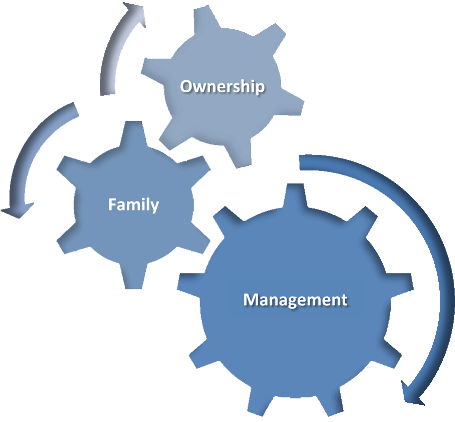
The three circles of this title refer to when the engagement of multiple family members in the business involves a blood (or marriage) relationship, participation in management decisions, and ownership. For our purposes, all three must be present in order for it to be a “Family Business.”

When all three factors are present, they set up a structural conflict that is challenging to deal with. Issac Newton postulated laws governing mass and attraction; the effect one body has on another in relation to its size. The problem with Newton’s laws is that they apply to two, and only two, bodies acting on each other. When there are three bodies of mass the laws become chaotic, since each change in one body not only alters its effect on the others, but immediately alters their effect on each other.

So it is with the laws governing family business relationships. When there are only two roles, effects are fairly predictable. One role, of course, is always the kinship between the parties. If only one of the family members has ownership, the roles in the workplace are pretty plain. If other family members have ownership, but don’t work in the company, their input can be anticipated and occurs within defined parameters. When family members hold two roles in the business, both employee/manager and ownership, each action in one area causes unequal and unpredictable reactions in the others.

In one business, a brother and sister were sold ownership, but until the parents were paid, the siblings remained dependent on their paychecks for normal living expenses. The brother worked long hours, kept a careful eye on expenses, and ran a “tight ship” when it came to employee issues. The sister came in late, left early, and was fond of showing employer largess by issuing unplanned raises to favorite workers. Her sibling and ownership relationships made it difficult to deal with her radically different management style. She felt that she had an equal “right” to run the company as she wished, even if it was the polar opposite of her brother’s style.

In this case, the brother’s solution was to force his sister to sell her stock, and continue to give her a salary conditioned on her no longer coming to the office. The company is better off, but they don’t speak to each other any more.

In another, a brother’s division of the family business underperformed those of his siblings. Eventually he left to work in another company, although he retains his ownership and they still get together for holidays.

The pressure of decision-making and implementation in a family business adds complexity to every situation. Is Dad overriding our opinions because of his greater experience and wisdom, or is it because he regards any dissent from his children as disrespect? Is Mom against the new initiative because she really judges the market to be weak, or is it just her natural inclination to protect what we already have? Has my brother really studied that opportunity, or is he just trying to do something on his own, without his big brother’s shadow over it?

Family members know each other too well to ever make a completely unbiased analysis. The best you can do is recognize the three circles that influence every action, and discuss the mass and attraction of each one when making decisions.