Exit Planning Tools for Business Owners

The Inexperienced Advisor – An Exit Planning Horror Story for Business Owners

 
This is a cautionary tale for business owners—one that’s “based on a true story.” The facts are real, although the exact sequence of events might raise questions if the IRS were to take a closer look.

A small business owner received a $1,000,000 offer to sell his company. He had already been thinking about retirement, and the chance to cash out felt like a perfect opportunity. His original plan had been to sell the business to a long-time employee through a promissory note, but that changed when the cash offer came along.

The business’s profits had always been modest, and the employee couldn’t match the offer. But the owner felt deep appreciation for the employee’s loyalty and past contributions. The employee already owned 10% of the stock, and the owner decided to reward him further by gifting an additional 10% just before the sale.

When the deal closed a few weeks later, they divided the proceeds: the owner received $800,000, and the employee got $200,000.

Here’s where things began to unravel.

The company’s tax preparer was a long-time friend of the owner—also his bookkeeper—who had served him faithfully for over 30 years. Their arrangement worked well for general business needs, and the owner saved money on fees. But the employee used a different advisor. And when tax season rolled around, that advisor raised some critical issues.

The Inexperienced Advisor, eyeglasses on top of a tax form

Let’s break it down.

The Letter of Intent was signed in January. The additional 10% stock was granted in February. The transaction closed in March. The valuation had been set by the sale offer, but little formal documentation existed for the transfer. The employee’s advisor flagged that the gifted stock constituted a $100,000 bonus—meaning it was taxed as ordinary income. At a 25% tax bracket, that single item triggered a $25,000 IRS bill.

Next came the issue of the company’s structure-

For years, the tax preparer had advised switching to an S Corporation, but the owner never followed through—it seemed like too much hassle. So the company remained a C Corporation and was subject to 21% corporate tax before distributions.

That meant the employee’s $200,000 had to be recalculated. His share was now about $158,000 after corporate taxes.

Of that amount, the original 10% was eligible for long-term capital gains treatment (20% rate), but the recently gifted 10% was double taxed: as short-term capital gain (at his 25% rate) and hit with a 20% parachute payment excise tax because of its proximity to the sale.

He paid nearly $55,000 in taxes just on that second 10%. And the hits kept coming.

With total compensation now over $200,000, the employee’s payout was subject to the 3.8% Net Investment Income tax (the “Obamacare” surcharge). And he still owed that initial $25,000 from the stock bonus.

When all the math was finished, his $200,000 “windfall” ended up being worth only $70,746.

That’s an effective tax rate of nearly 65%.

And the owner? He was double taxed, too. His “cut-rate” accounting services and the decision to avoid S Corporation status ended up costing far more than they saved.

Could it have gone differently? Absolutely.

For a relatively small investment in expert guidance, they might have restructured the transaction. For instance, compensating the employee with a cash bonus instead of stock would have made the payment deductible to the company, taxed only once as ordinary income to the employee.

But none of that was considered—because there was no experienced advisor at the table.

If you’re considering selling your business, don’t go it alone.

Exit planning isn’t just about getting a good offer—it’s about protecting your value and avoiding costly mistakes. Engage with a seasoned advisor who understands the tax, legal, and strategic layers of a business transition.

The cost of advice is small compared to what it could save you.

-Special thanks to Steven A. Bankler, CPA, for his help with this article.

John F. Dini develops transition and succession strategies that allow business owners to exit their companies on their own schedule, with the proceeds they seek and complete control over the process. He takes a coaching approach to client engagements, focusing on helping owners of companies with $1M to $250M in revenue achieve both their desired lifestyles and legacies.

What Business Owners Should Know from the 5th Annual Exit Planners Survey

 
Between February 1 and March 2, 2025, ExitMap conducted its 5th annual survey of professionals who help business owners plan successful exits. This is the only survey that gathers insight across multiple advisory specialties—offering a wide-angle view of the professionals supporting entrepreneurs like you during one of the most critical transitions of your life.

The survey included 30 questions and was distributed to over 7,000 experienced advisors worldwide. These are professionals with recognized credentials in exit planning, active roles in professional organizations, or who publicly position themselves as specialists in business transition. We received 434 responses from advisors in eight disciplines, representing six countries and 47 U.S. states, resulting in a 99% confidence level and a margin of error of 3.6%. Statistically, the results offer a strong picture of the current state of the exit planning landscape.

What Does This Mean for You as a Business Owner?

Exit planning is no longer something only for ageing Baby Boomers. It has evolved into a strategic planning tool for many owners in Generation X and even younger. Whether you’re planning to exit soon or simply want to be ready for future opportunities, exit planning helps maximize business value and align your business with personal and financial goals.

Since the pandemic, the number of advisors in this field has grown by 70%, with a 23% increase just last year. That expansion reflects increasing demand—but surprisingly, most advisors say they’re busier than ever. In 2024, 88% reported as many or more planning engagements compared to the previous year.

What Are Exit Planning Advisors Saying?

    •70% charge separate fees for exit planning services—this work is specialized and structured.

    •96% say exit planning leads to additional support for their clients—like tax strategy, estate planning, and business improvement.

    •57% expect to earn over $50,000 this year from exit-related work.

    •69% focus on companies valued under $3 million, making their services accessible to smaller businesses.

    •80% work with clients remotely, so location isn’t a barrier.

    •Over half are 55+ years old, indicating deep professional experience.

Why an Advisor is Essential in Your Exit Strategy

If you’re like most owners, your business is your largest and least liquid asset. The emotional and financial stakes are high when you’re preparing to exit. The growing network of experienced advisors is ready to guide you through this complex process—helping you make informed decisions, increase business value, and ensure that your exit supports your long-term personal and financial goals.

Planning early gives you more strategic options. Unfortunately, many owners delay until a transition is urgent, reducing flexibility and potential outcomes. Advisors also report challenges in coordinating across specialties and maintaining long-term planning engagement, reinforcing how valuable a committed, collaborative advisor can be throughout the journey.

Bottom Line

The transition of Baby Boomer-owned businesses—estimated at $10 to $17 trillion in assets—is driving rapid growth in exit planning. Many of these are family-run or bootstrapped businesses that have grown into significant mid-market companies. Exiting these businesses often requires a team: financial planners, CPAs, attorneys, brokers, bankers, and more.

As the field grows, so does the availability of structured planning tools like those from ExitMap, which advisors use to help owners like you take the first step. If a future transition is anywhere on your horizon, the time to start planning is now—and the first move is finding an experienced advisor to help you do it right.

John F. Dini develops transition and succession strategies that allow business owners to exit their companies on their own schedule, with the proceeds they seek and complete control over the process. He takes a coaching approach to client engagements, focusing on helping owners of companies with $1M to $250M in revenue achieve both their desired lifestyles and legacies.

Private Equity Reputation

 
We began this series by saying that Private Equity reputation is as the Great Satan to some, and a savior to others, depending on the personal experience of the speakers. In fact, both reputations are well deserved, but neither can be universally applied.

The “Great Satan” Private Equity Reputation


Man with a net chasing a gold coin walking on legsPEGs buy companies for the express purpose of improving their performance. That often comes with considerable pain for employees. A Searchfunder I know said recently “I’m looking at this acquisition because the owner thinks he is running an efficient company, where I see at least ten points that could be dropping to the bottom line.”

Efficiency is good, but too often it flies in the face of what made a company successful. In one example I recall, the PEG principals spoke to the assembled employees the day after closing on the business. They said “We bought this company for its culture and its people. Those are the most important assets to us.”

The cuts started coming the following Monday. Thanksgiving turkeys were “outdated.” Gone. All bonuses would be performance-based, so extra bonuses at Christmas would be discontinued. Season seats for the local sports franchise – gone. (Most of those went to customers.) Weekend overtime – gone. Schedules would be rearranged so that weekend workers were now scheduled for Saturdays and Sundays and got fewer hours during the week to make up for it.

Employee discounts on the company’s products – gone. Partial subsidies for family health insurance, well by now you are getting the gist. The flood of cuts was shocking and seemed unending. The flood of resignations started soon after.

By the way, the PEG missed its planned flip date (when they were supposed to sell to a bigger PEG) because of poor results and eventually took the company into Chapter 11.
I wish I could say that this type of result was unique, but it happens in far too many cases.

The “Savior” Private Equity Reputation


There is another reality. About 50% of all the privately held employers in the United States are Baby Boomers. The youngest of these are now turning 60. Many have built substantial enterprises whose value is far beyond what a younger entrepreneur can afford.

Private Equity has morphed into a many-headed creature, capable of acquiring almost any size business with value. It will never be for the mom-and-pop businesses that merely earn a living for the owner. As Doug Tatum says in No Man’s Land, they have grown to a level where they provide “wealth” to the owner equivalent to three salaries. Unfortunately, the owner must hold down three jobs for it to work.

But businesses with real cash flow, from a few hundred thousand dollars to a few hundred million, can find a tranche of PEGs who will consider their acquisition. Some specialize in minority ownership, or in funding the transition to a new generation of owners. Like it or not, these will be the saving of an entire generation who became successful by building a illiquid asset.

The latest estimate (from the Exit Planning Institute) is that these owners have $14 trillion dollars locked up in these illiquid assets – their companies. It that was an economy, it would be third in the world behind only the USA and China.

Reputation Counts


Many business owners are dazzled by the money a PEG has. With 17,000 of them out there, “We have money” is no longer as impressive as it once was. If a PEG comes calling, sellers (and their advisors) should carefully research their track record. If they lead with a guy “just like you” who owned a previous acquisition, be cautious. In most cases, he or she is compensated for adding to their portfolio.

Instead, talk to other owners who were acquired previously and are no longer active in the business. Look carefully into the acquirer’s experience in your industry. Unfortunately, “We have money” sometimes dazzles the PEG too. They begin to think financial manipulation is the only thing needed to make any business more successful.

Private Equity reputation is important. It will help you decide whether you should be discussing “show me the money” or “show me the future.”


John F. Dini develops transition and succession strategies that allow business owners to exit their companies on their own schedule, with the proceeds they seek and complete control over the process. He takes a coaching approach to client engagements, focusing on helping owners of companies with $1M to $250M in revenue achieve both their desired lifestyles and legacies.

Private Equity Leverage

 
red coin purse full of golden coins surrounded by a silver toothed bear trapPrivate equity leverage can dramatically increase ROI, but it can also be a trap. In our previous article, we discussed the general structure of Private Equity, how it works, and the types of Private Equity Groups (PEGs). They have grown rapidly as an alternative investment that produces far better returns than Treasury Bills or publicly traded equities.

The Power of OPM (Other People’s Money)


How do they provide these enviable 18% to 25% returns on an investment? The simple answer is leverage. An example most business owners can easily comprehend is a real estate mortgage. You put down $100,000 on a $500,000 building. The mortgage, especially in the first few years, is largely interest expense. You lease the building for a rental rate that covers your mortgage payment and expenses. Two years later you sell the building for $700,000. How much did you make?

The obvious answer is $200,000, but what is your Return on Investment (ROI)? If you said 40% you’d technically be correct. You made a $200,000 profit on a $500,000 investment. But what was your cash-on-cash return?

That is 200%. You actually invested $100,000 of your own money and used the building to secure a loan for the rest. Your profit was $200,000 on a $100,000 investment.

Private Equity Leverage(Other People’s Money)


Extend this example to buying a business. The business makes about $2,000,000 a year. (For the sake of simplicity, we won’t discuss here the differences between cash flow and profit.) The agreed-upon acquisition price is $10,000,000, or five times the profits. The PEG contributes $2,000,000 as a downpayment and finances the remaining $8,000,000. The cash flow of the business must cover the loan payments and leave enough working capital for operations.

A 5% loan amortized over 20 years requires a payment of about $53,000 a month or $636,000 a year. The remaining cash flow ($1,364,000) produces a return of 68% annually on the purchase.

Of course, the Limited Partner investors don’t get all 68%. Some must be kept as working capital for expanding operations. The PEG receives substantial fees for creating the deal and overseeing the investment.

In fact, the 25% return to the investors is only part of the story. If the PEG can double the company to a $4,000,000 profit level, even the exact same 5x multiple on exit could produce a $20,000,000 sale, or an $18,000,000 return on the original $2,000,000 cash outlay. That’s a 900% ROI.

Leveraging the Leverage


Buying a middle-market business with the structure outlined above would be lucrative enough, but of course, as professionals, the PEG would like to maximize their return. They frequently cut expenses dramatically upon acquisition (more on this in the next article.)

Often, they will line up a secondary loan, using the company’s cash flow to reduce or eliminate their downpayment exposure.

Private equity leverageDuring the low-interest environment of the last decade, PEGs could negotiate even more favorable terms. If you replace the 5% loan with a 2.5% loan, the annual cost is reduced to $509,000 annually, leaving a 75% return to work with.

Traditionally, most of the loan terms in private equity purchases reset after a few years. Refinancing at 9% raises the loan cost to about $865,000. Still, a 57% ROI is acceptable, if the business is thriving and the other expenses are kept under control. If the cash flow is covering a secondary loan at an even higher rate to replace the downpayment, or it’s been pledged to cover other debt outside the business, the picture might not be as rosy.


John F. Dini develops transition and succession strategies that allow business owners to exit their companies on their own schedule, with the proceeds they seek and complete control over the process. He takes a coaching approach to client engagements, focusing on helping owners of companies with $1M to $250M in revenue achieve both their desired lifestyles and legacies.
A Cash Balance Plan May be a Great Tax- Reducing Benefit to A Business Owner


Like most business owners, you’re likely exploring ways to strategically grow your revenue, increase profits, and minimize taxes. This is a common goal. As your cash flows increase, you may find yourself seeking ways to reduce your growing tax burden. Often, we explore sensible capital expenditures or business reinvestments that align with your strategic goals, which is a healthy exercise.

Growing the Business, Graph on top if ipad with eyeglassesBut sometimes, business owners could benefit from strategies to accumulate personal assets and reduce taxes. Depending on specific criteria, a Cash Balance Plan could be a powerful tool to achieve this objective and significantly reduce your tax burden.

What is a Cash Balance Plan? It’s an ERISA-based hybrid plan, a unique blend of a Defined Benefit Plan and a Money Purchase Plan. To plan participants, it resembles a Defined Contribution Plan, like a 401(k), but the IRS treats it as a Defined Benefit Plan. This plan operates alongside your 401(k)/ Profit Sharing Plan, offering an additional tax-deferral strategy for accumulating retirement assets.

Cash Balance Plans are effective tax-qualified retirement funding vehicles designed to help business owners aggressively accumulate retirement assets. They are beneficial if they have fallen behind in their retirement savings goals.

Like a Money Purchase Plan, a Cash Balance Plan has fixed contributions for each participant each year. Additionally, plan participants receive interest credits based on the established interest rate defined in the plan. Often viewed as a feature of flexibility, an increase or a decrease in the value of the investments within the plan does not affect the benefits promised to the participants. Gains and losses from the plan’s investments reduce or increase the plan sponsors contributions. The employer oversees the risk/reward design of the investments with the assistance of a professional investment advisor. A portfolio is designed for reasonable and relatively stable long-term growth.

Here are some itemized potential benefits for the business owner:

  1. Significant tax savings. The funds contributed to the plan in the first year of implementation are tax-deductible and considered an ” above-the-line” deduction. Also, employees with high earnings may be able to accelerate their savings. Administration fees may be tax-deductible.
     
  2. Protection of assets from creditors. The Cash Balance Plan is a tax-qualified ERISA plan, so it is protected from creditors.
     
  3. The plan can help attract and retain valued employees. Many younger employees may find an employer-funded retirement plan attractive.
     
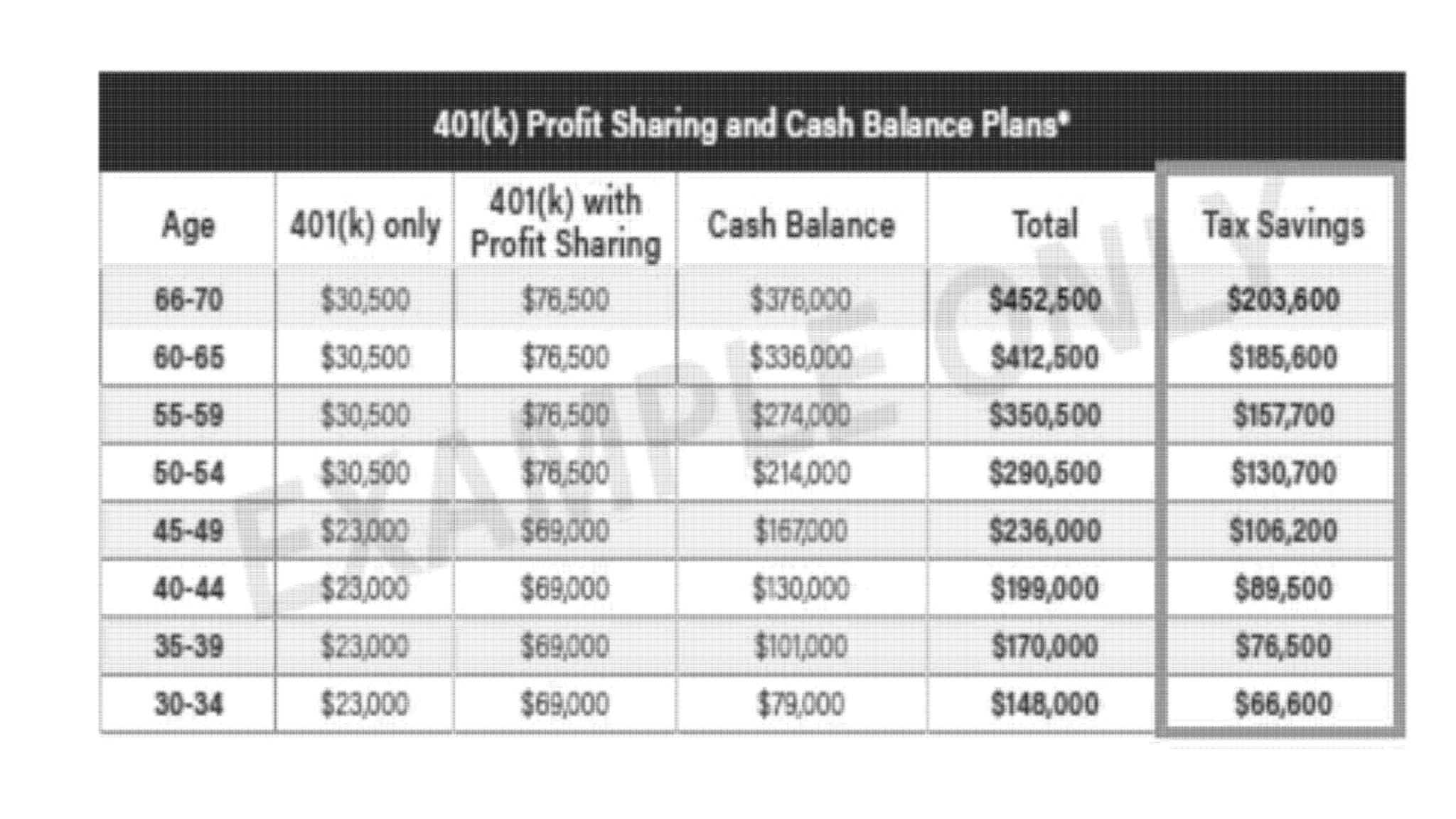
  4. Cash Balance Plans can help business owners accelerate their retirement savings. In 2024, the potential contribution to a Cash balance plan can be $376,000 (for participants aged 66 -70 and in a top income bracket). See the table below for contribution limits and potential tax savings.
     

Below is a table that illustrates the maximum contribution for a 401(k) based on age, along with the profit sharing and potential contribution of the Cash Balance Plan. The CB contribution is based on age and income.
Source: Cash Balance 101: FuturePlan by Ascensus

Assets in the plan are not allocated into separate accounts for the participants, and the participants cannot direct the investments within the plan. The investments and contributions are in a pooled fund managed by the Trustees.

One of the unique features of a Cash Balance Plan is its age-discriminatory aspect. The older the business owner, the more income they can allocate to the plan pre-tax. Conversely, the younger the other plan participants (employees), the lower the contribution requirements are to the sponsor (owner). This makes it ideal for a company where the owner is considerably older than the other plan participants, especially if the owner is in their 50s or older.

Another ideal scenario for a Cash Balance Plan is when the owner’s or potential income is significantly higher than the other employees. This income disparity is a key factor in the plan’s effectiveness and should be considered when evaluating its suitability for your business. Some requirements must be met. The CB plan can be implemented if the annual non-discrimination requirements are satisfied. At a minimum, a CB plan is required to cover 40% of employees or 50 employees, whichever is less.

Some owners look for ways to increase their cash flow to help fund a Cash Balance Plan, such as R&D Tax Credits, Employee Retention Credits, etc. However, these need to be vetted by a tax credit specialist, and current laws and eligibility must be followed carefully. But suppose the conditions are suitable for the owner. In that case, they are interested in saving on taxes and accelerating retirement savings, and it helps retain employees; it might make sense to perform an employee census-based analysis.

Steven Zeller is a Certified Business Exit Planner, Certified Financial Planner, Accredited Investment Fiduciary, and Co-Founder and President of Zeller Kern Wealth Advisors. He advises business owners with developing exit plans, increasing business value, employee retention, executive bonus plans, etc. He can be reached at szeller@zellerkern.com