Exit Planning Tools for Business Owners

The Inexperienced Advisor – An Exit Planning Horror Story for Business Owners

 
This is a cautionary tale for business owners—one that’s “based on a true story.” The facts are real, although the exact sequence of events might raise questions if the IRS were to take a closer look.

A small business owner received a $1,000,000 offer to sell his company. He had already been thinking about retirement, and the chance to cash out felt like a perfect opportunity. His original plan had been to sell the business to a long-time employee through a promissory note, but that changed when the cash offer came along.

The business’s profits had always been modest, and the employee couldn’t match the offer. But the owner felt deep appreciation for the employee’s loyalty and past contributions. The employee already owned 10% of the stock, and the owner decided to reward him further by gifting an additional 10% just before the sale.

When the deal closed a few weeks later, they divided the proceeds: the owner received $800,000, and the employee got $200,000.

Here’s where things began to unravel.

The company’s tax preparer was a long-time friend of the owner—also his bookkeeper—who had served him faithfully for over 30 years. Their arrangement worked well for general business needs, and the owner saved money on fees. But the employee used a different advisor. And when tax season rolled around, that advisor raised some critical issues.

The Inexperienced Advisor, eyeglasses on top of a tax form

Let’s break it down.

The Letter of Intent was signed in January. The additional 10% stock was granted in February. The transaction closed in March. The valuation had been set by the sale offer, but little formal documentation existed for the transfer. The employee’s advisor flagged that the gifted stock constituted a $100,000 bonus—meaning it was taxed as ordinary income. At a 25% tax bracket, that single item triggered a $25,000 IRS bill.

Next came the issue of the company’s structure-

For years, the tax preparer had advised switching to an S Corporation, but the owner never followed through—it seemed like too much hassle. So the company remained a C Corporation and was subject to 21% corporate tax before distributions.

That meant the employee’s $200,000 had to be recalculated. His share was now about $158,000 after corporate taxes.

Of that amount, the original 10% was eligible for long-term capital gains treatment (20% rate), but the recently gifted 10% was double taxed: as short-term capital gain (at his 25% rate) and hit with a 20% parachute payment excise tax because of its proximity to the sale.

He paid nearly $55,000 in taxes just on that second 10%. And the hits kept coming.

With total compensation now over $200,000, the employee’s payout was subject to the 3.8% Net Investment Income tax (the “Obamacare” surcharge). And he still owed that initial $25,000 from the stock bonus.

When all the math was finished, his $200,000 “windfall” ended up being worth only $70,746.

That’s an effective tax rate of nearly 65%.

And the owner? He was double taxed, too. His “cut-rate” accounting services and the decision to avoid S Corporation status ended up costing far more than they saved.

Could it have gone differently? Absolutely.

For a relatively small investment in expert guidance, they might have restructured the transaction. For instance, compensating the employee with a cash bonus instead of stock would have made the payment deductible to the company, taxed only once as ordinary income to the employee.

But none of that was considered—because there was no experienced advisor at the table.

If you’re considering selling your business, don’t go it alone.

Exit planning isn’t just about getting a good offer—it’s about protecting your value and avoiding costly mistakes. Engage with a seasoned advisor who understands the tax, legal, and strategic layers of a business transition.

The cost of advice is small compared to what it could save you.

-Special thanks to Steven A. Bankler, CPA, for his help with this article.

John F. Dini develops transition and succession strategies that allow business owners to exit their companies on their own schedule, with the proceeds they seek and complete control over the process. He takes a coaching approach to client engagements, focusing on helping owners of companies with $1M to $250M in revenue achieve both their desired lifestyles and legacies.

A Cash Balance Plan May be a Great Tax- Reducing Benefit to A Business Owner


Like most business owners, you’re likely exploring ways to strategically grow your revenue, increase profits, and minimize taxes. This is a common goal. As your cash flows increase, you may find yourself seeking ways to reduce your growing tax burden. Often, we explore sensible capital expenditures or business reinvestments that align with your strategic goals, which is a healthy exercise.

Growing the Business, Graph on top if ipad with eyeglassesBut sometimes, business owners could benefit from strategies to accumulate personal assets and reduce taxes. Depending on specific criteria, a Cash Balance Plan could be a powerful tool to achieve this objective and significantly reduce your tax burden.

What is a Cash Balance Plan? It’s an ERISA-based hybrid plan, a unique blend of a Defined Benefit Plan and a Money Purchase Plan. To plan participants, it resembles a Defined Contribution Plan, like a 401(k), but the IRS treats it as a Defined Benefit Plan. This plan operates alongside your 401(k)/ Profit Sharing Plan, offering an additional tax-deferral strategy for accumulating retirement assets.

Cash Balance Plans are effective tax-qualified retirement funding vehicles designed to help business owners aggressively accumulate retirement assets. They are beneficial if they have fallen behind in their retirement savings goals.

Like a Money Purchase Plan, a Cash Balance Plan has fixed contributions for each participant each year. Additionally, plan participants receive interest credits based on the established interest rate defined in the plan. Often viewed as a feature of flexibility, an increase or a decrease in the value of the investments within the plan does not affect the benefits promised to the participants. Gains and losses from the plan’s investments reduce or increase the plan sponsors contributions. The employer oversees the risk/reward design of the investments with the assistance of a professional investment advisor. A portfolio is designed for reasonable and relatively stable long-term growth.

Here are some itemized potential benefits for the business owner:

  1. Significant tax savings. The funds contributed to the plan in the first year of implementation are tax-deductible and considered an ” above-the-line” deduction. Also, employees with high earnings may be able to accelerate their savings. Administration fees may be tax-deductible.
     
  2. Protection of assets from creditors. The Cash Balance Plan is a tax-qualified ERISA plan, so it is protected from creditors.
     
  3. The plan can help attract and retain valued employees. Many younger employees may find an employer-funded retirement plan attractive.
     
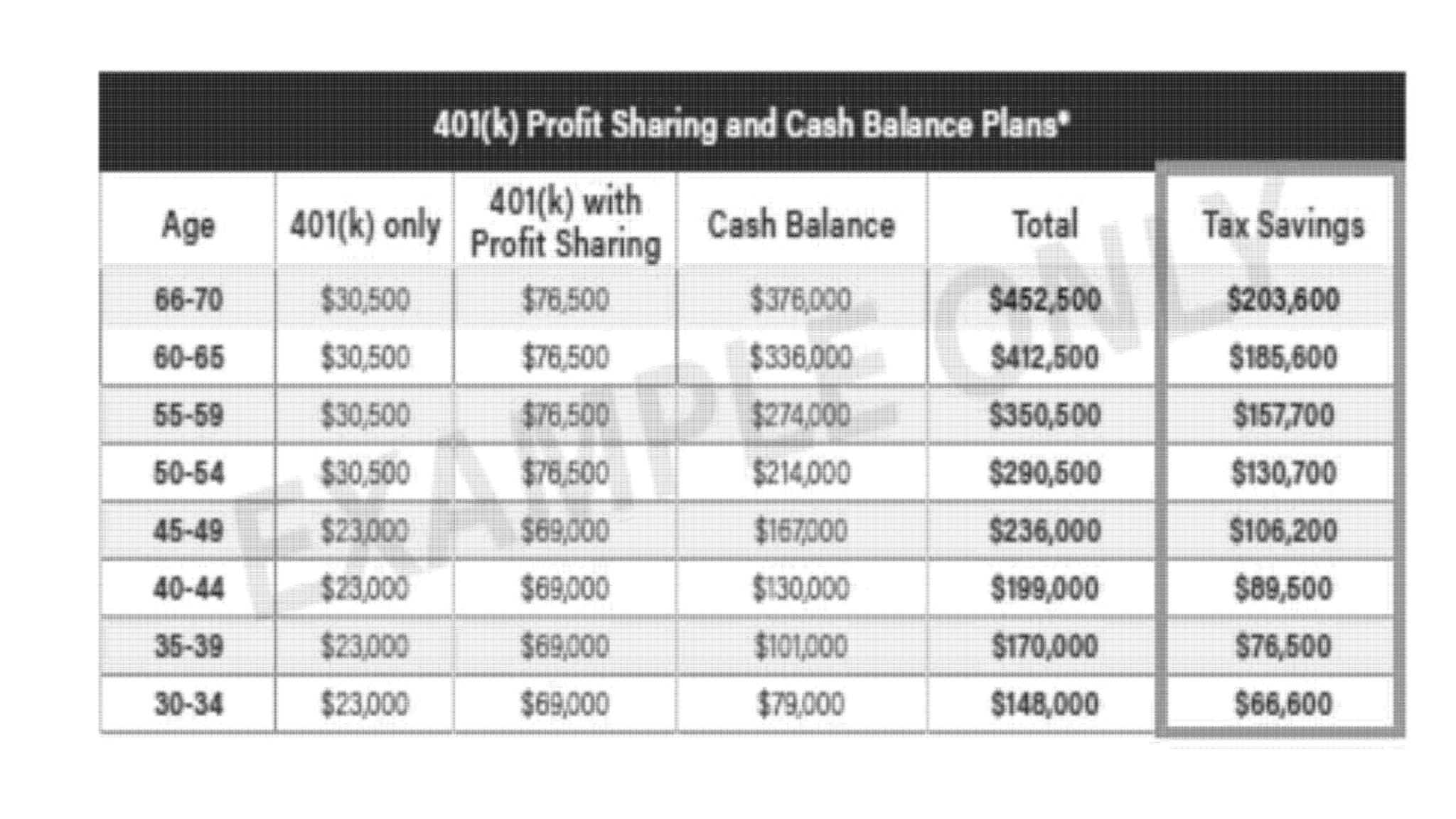
  4. Cash Balance Plans can help business owners accelerate their retirement savings. In 2024, the potential contribution to a Cash balance plan can be $376,000 (for participants aged 66 -70 and in a top income bracket). See the table below for contribution limits and potential tax savings.
     

Below is a table that illustrates the maximum contribution for a 401(k) based on age, along with the profit sharing and potential contribution of the Cash Balance Plan. The CB contribution is based on age and income.
Source: Cash Balance 101: FuturePlan by Ascensus

Assets in the plan are not allocated into separate accounts for the participants, and the participants cannot direct the investments within the plan. The investments and contributions are in a pooled fund managed by the Trustees.

One of the unique features of a Cash Balance Plan is its age-discriminatory aspect. The older the business owner, the more income they can allocate to the plan pre-tax. Conversely, the younger the other plan participants (employees), the lower the contribution requirements are to the sponsor (owner). This makes it ideal for a company where the owner is considerably older than the other plan participants, especially if the owner is in their 50s or older.

Another ideal scenario for a Cash Balance Plan is when the owner’s or potential income is significantly higher than the other employees. This income disparity is a key factor in the plan’s effectiveness and should be considered when evaluating its suitability for your business. Some requirements must be met. The CB plan can be implemented if the annual non-discrimination requirements are satisfied. At a minimum, a CB plan is required to cover 40% of employees or 50 employees, whichever is less.

Some owners look for ways to increase their cash flow to help fund a Cash Balance Plan, such as R&D Tax Credits, Employee Retention Credits, etc. However, these need to be vetted by a tax credit specialist, and current laws and eligibility must be followed carefully. But suppose the conditions are suitable for the owner. In that case, they are interested in saving on taxes and accelerating retirement savings, and it helps retain employees; it might make sense to perform an employee census-based analysis.

Steven Zeller is a Certified Business Exit Planner, Certified Financial Planner, Accredited Investment Fiduciary, and Co-Founder and President of Zeller Kern Wealth Advisors. He advises business owners with developing exit plans, increasing business value, employee retention, executive bonus plans, etc. He can be reached at szeller@zellerkern.com