Exit Planning Tools for Business Owners

EBITDAC : What is Your Business Worth Now?

Several friends have sent me a picture of an EBITDAC coffee mug this week. As it states, EBITDAC stands for Earnings Before Interest, Taxes, Depreciation, Amortization and Coronavirus. Will this be the new measure of cash flow for valuing your business?
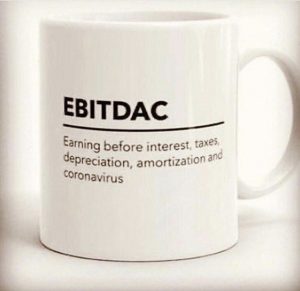
EBITDACA bleak joke, but one that is on the minds of many business owners, especially Baby Boomers in their late 50s and 60s. Many were postponing their exit planning because business has been so good. As one client told me, “In March we had the best year in the history of my company. It looks like April might be the worst.”

Downturns aren’t new, and recent history has more “Black Swan” downturns than most. Boomer owners have lived through the dot-com crash, 9-11, and the financial/housing bust. Even the Great Recession, however, was when most Boomers were in their mid-40s to early 60s. Most had ample time to recover, and to resume their business-building activities.

This downturn hits 4,000,000 Boomer owners when the youngest is at least 55 years old. The recovery time is uncertain, and regulatory restrictions on their businesses may be reimposed, perhaps more than once.

Factoring the Coronavirus in Valuations

Most Main Street acquisitions (under $3,000,000) rely on financial results over the previous five years for valuation. Those years have generally been good. In the middle market, professional buyers’ due diligence requests often seek results from 2008-2009 as an indicator of a business’s resilience in a contracting economy.

I think we can safely assume that both Main Street and mid-market acquirers will be carefully looking at the sustainability of your business through COVID-19. How much it affects your company’s valuation will depend largely on what type of business you own, and how you reacted to both any shutdown and the period immediately following.

One issue will be how buyers perceive the impact of Paycheck Protection Program loans and their forgiveness. It appears at the moment that the PPP loans will not be considered taxable income when forgiven. There are IRS rules for non-taxable loan forgiveness, but it will likely still appear as additional margin on your books. (The expenses it paid will still be deductible.)

You can be certain that buyers will be backing out the PPP loan forgiveness when valuing your business. They won’t be very interested in paying multiples of a one-time “free money” event.

EBITDAC : Short and Long Term Impact

Some businesses will see an immediate effect on their selling prices. Others may have a lingering change in how buyers look at their worth.

First, buyers will look at the scope of the coronavirus’ impact. Restaurants, caterers, event support, transportation (airlines, rental cars, party buses) and other hospitality related industries will be the worst. Not only are they the most affected, but they face the possibility that they resume with limitations on their business (social distancing in restaurants or limited passengers in vehicles, for example.) Any buyer would have to anticipate another period where they can’t generate substantial, or any, revenue.

If a business like those survives the shutdown, finding a buyer will be challenging. Third-party lenders will shy away from any involvement. Cash flow will remain tight, and credit will be harder to find.

The good news for those businesses is that the virus will end. When it is no longer a threat (presumably either because we find a vaccine, or we build herd immunity after a couple of seasons,) valuations should return to something more normal.

Other businesses will see valuations change over a longer period of time, and for different  reasons. They will be judged either by their ability to recover quickly, or by how their model changes to take advantage of life after the virus.

Regardless of the impact, some owners will use the pandemic as an excuse for years to come. Others will adjust and move forward. (See my description of an owner who was still blaming the Great Recession a decade later here.)

Planning for Your Comeback

Whether your business is essential and working much like before the pandemic, or non-essential but functioning pretty well remotely. this virus is going to change your strategy.

For an obvious example, lets take video conferencing. How are you preparing your sales team for the return to normal? Will they be more efficient? Are they able to cold call? Should their expense accounts be lower? Or are they (and you) just waiting to go back to what they did before?

If you are a manufacturer or a contractor, perhaps your business has been very healthy during this lock-down. What will happen afterwards? Will new competitors push into your market to replace business that they lost? Might some customers fade away, while others discover a newfound need for your offerings?

If you are surviving, how can you thrive? Do you expect landlords with empty space to negotiate cheaper rents? Will some skilled employees be looking for new jobs? Should others become pricier because of increased demand for their skills? Can the automation you implemented for remote work be extended to new efficiencies or new opportunities?

EBITDAC and Post-Coronavirus Exit Planning

If you were anticipating retirement before the pandemic, are you accelerating your plans or putting them on hold for a while longer?

In either case, you’ll need to understand the impact of the virus on your company’s value. EBITDAC 2It may be dramatic and immediate, or it may be only obvious afterwards when your performance is matched against that of your peers.

The definition of a Black Swan is “An unpredictable or unforeseen event, typically one with extreme consequences.” COVID-19 certainly fits the definition. It already has extreme consequences, but many of those are yet to come.

It’s not hard to figure out. Those who plan for a different world will do better than those who are taken by surprise. In either case, the impact of the “C” in EBITDAC will greatly influence any value generated by your transition from your business.


John F. Dini, CExP, CEPA is an exit planning coach and the President of MPN Incorporated in San Antonio Texas. He is the publisher of Awake at 2 o’clock, and has authored three books on business ownership.

Manage Activities; Lead for Results

A few weeks ago I posted a comment in the Business Journals Leadership Trust Forum about a life lesson I learned. The difference between effort and outcomes – Manage Activities; Lead for Results.

They reached out and asked if I could expand my comments a bit. Those of you who know me won’t find it surprising that it grew into an article.

You can find it here. I hope you enjoy it. Remember, lead for results.

 
Invest 15 Minutes and take our FREE Exit Readiness Assessment. We do not request any confidential information.

John F. Dini develops transition and succession strategies that allow business owners to exit their companies on their own schedule, with the proceeds they seek and complete control over the process. He takes a coaching approach to client engagements, focusing on helping owners of companies with $1M to $250M in revenue achieve both their desired lifestyles and legacies

Is Google Making Us Stoopid?

As an Exit Planner, most of my engagements involve assessing a management team. They may be the intended buyers of the company, or else they are key factors in the saleability of the business.

The biggest and most frequent complaint I hear about managers is that they don’t know how to THINK. Business owners lament the inability of employees to discern critical paths, assess alternatives, or analyze complex problems.

Examples of Thinking Shortfalls

A CPA is doing a final review of a client’s tax returns, as prepared by an associate. As with many business owners, the client has two related entities, one acting as the management company for the other.

The reviewing partner notices the income from management fees in one entity, but no corresponding expense deduction in the other. The associate explains that the client’s books didn’t show the offsetting expense, so he ignored it.

The owner of an IT services company receives an irate call from a client. His technician has just spent two billable hours on the client’s PC, and it still won’t print his documents.

When the employee is asked for an explanation, he points out that the client said he needed updates to his printer drivers, and that is exactly what he (the technician) did. At no point did he try to determine whether updating the drivers would solve the customer’s problem, or even what that problem was.

The customer made a request, and the technician complied. He didn’t perceive the customer’s lack of technical knowledge as a factor.

As the adage goes, “When someone asks you for a drill, what he really wants is a hole.” If you are in any business where the customer expects you to be more knowledgeable than him (and why would he hire you otherwise?) thinking is a core competency.

I Can Look Up the Answer

Numerous educators and managers have related to me the effect of the Internet. Students resist rote learning. Employees refuse to train in procedures. Their answer is ubiquitous; “Why do I have to know that? I can look it up whenever I need it.”

In some circles, gaining “knowledge” is a game of speed and skill. Participants in a conversation whip out their electronic lozenges upon any reference to a historical fact, person or thing name, geography question, et al, ad infinitum. (Don’t know Latin? No problem. Google it.)

What is eroding is the concept that an answer may not be the best answer, or even a good answer. It’s just an answer.

Life isn’t “Fill In the Blanks”

Getting an answer doesn’t mean you’ve solved a problem. What we are losing is the ability for critical thinking. For saying “Wait a minute. That is one approach, but might there be others? Is there a better answer?”

We used to have to work through that step by step in our brains. Now we are becoming conditioned to accepting the answer on a little screen as the final word.  It’s great for learning how to change a faucet, but maybe not so hot for solving a customer complaint.

Your management team is the most important factor in realizing value for your business.  If you are planning a fully controlled (time, method, and proceeds) internal transition, they are your buyers and the guarantors of any financing you may underwrite. If you are selling to an external buyer, he or she wants to see a business capable of running (and making good decisions) without you.

Either way, you need to teach them how to think.

Invest 15 Minutes and take our FREE Exit Readiness Assessment. We do not request any confidential information.

John F. Dini develops transition and succession strategies that allow business owners to exit their companies on their own schedule, with the proceeds they seek and complete control over the process. He takes a coaching approach to client engagements, focusing on helping owners of companies with $1M to $250M in revenue achieve both their desired lifestyles and legacies

Exit Planning: Controlling Your Choices

Many owners are reluctant to plan for their departure from the business. In some cases it’s because they are too comfortable with ambiguity (see my previous post.) For others it is because they fear losing control. They believe that setting a final date for their departure, even tentatively, starts a process that will take on a life of its own.

The tag line of this column is “Control the most important financial event of your life.” Control is the key. Refusing to deal with the realities of an eventual transition from the business is surrendering control. Sooner or later, something will happen that requires a transfer of the business. Then it is too late to exercise the options you have now.

Exit planning three, five or ten years before your anticipated transition gives you a clearer picture of the direction your company needs to take if it is going to serve your personal objectives.

All business owners want to grow their companies, make more money and work a bit less, but few things are more disappointing than finding out that the work you put in won’t result in the outcome you expected.

What if you work yourself to the point of exhaustion, only to find that you are too critical to the company’s success for anyone else to buy it without tying you into a long term employment agreement? What if you rapidly grow your revenues, but discover that your margins are too thin to attract a decent acquirer? What if you build a great management team, but they leave to start a competing business? What if you invest in new equipment  that looks great, but doesn’t add to the value of your company?

Understanding Your Choices

All these things would be addressed in a comprehensive exit plan. It’s not only about your life after the business, it’s about the life of the business after you. Exit planning requires that you look at your company through both the eyes of both a seller and of a buyer.

As a seller, you have certain goals for what you would accept as a successful exit. Usually those are financial, but other factors sometimes count for even more than the sale price. What future do you envision for your employees and customers following the sale? Is the company’s reputation, or it’s contribution to the community important to you? Answering these questions could have an impact on the type of buyer you will consider.

What are the intangible assets of your business? Are your employees able to make good business decisions without your oversight? Do they dependably execute their roles according to documented processes with consistently high levels of quality? The ability to duplicate your success is the single most important factor in a buyer’s calculation of value.

How sticky would your company’s relationship with key employees be in your absence? Are they committed to the company because of a sense of ownership, actual ownership, or long-term incentives? If their only tie is personal loyalty to you, the value proposition to a buyer is a lot riskier.

Controlling Your Choices

All these questions should be part of your planning. Yet most owners don’t ask them until they are on the brink of retiring. That is a mistake. Knowing what you want to accomplish, or in other words – where your finish line is, is critical to building your business in the right way, in the right direction.

Having an exit plan doesn’t mean that you have to implement it on a specific date. You can choose “wait and watch” from the options outlined in this short video on the Five Roads to a Business Exit.

If you know your destination, your choice of a pathway becomes much easier.

Ambiguity Kills Value

Ambiguity kills value. That was a key point in a white paper from Orange Kiwi that I read over the holidays. Taken from the PhD thesis of Dr. Allie Taylor, the paper describes the psychological profile of  entrepreneurs, and their historical reluctance to begin an exit planning process.

According to Dr. Taylor, entrepreneurs have five major behavioral traits; Risk Taking, Innovativeness, Need for Achievement, tolerance for Ambiguity and a locus for Control. This follows closely my description of the mind of an entrepreneur in Hunting in a Farmer’s World. In that book I discuss the traits of tenacious problem solving and the ability to navigate in the fog.

Ambiguity and Dopamine

That ability to choose a path where others don’t see a way forward is key to a business owner’s ability to stomach risk. What Dr. Taylor points out, however, is that some owners fall in love with their own tolerance for ambiguity. As Simon Sinek points out in Leaders Eat Last (and I also discuss in Hunting,) problem solving provides an owner with a little shot of Dopamine dozens, or even scores of times daily.

Dopamine is the same neurotransmitter that drives substance abuse. In very real terms, an owner’s need for regular dopamine titillations can make decision making addictive. Anticipating a life without the business can subconsciously create a fear of life without the business.  

That’s why owners are reluctant to discuss exit planning. Despite the obvious wisdom of controlling the most important financial event of a lifetime, the personal void that lies beyond ownership is scary. As with many other potentially unpleasant things, from going to the dentist to funeral prearrangements, it’s easy to deal with it…later.

Ambiguity Kills Value

The problem with embracing ambiguity too much is that it can damage your business. Management by firefighting is costly. As Abraham Lincoln said, “If I had eight hours to cut down a tree, I’d spend seven of those sharpening my saw,” Fixing problems almost always costs more than preventing them. Dealing with distractions reduces the time you have available for selling, creating or teaching.

Avoiding the uncomfortable task of exit planning leaves you much more likely to deal with it in response to one of the Dismal D’s. (Death, Disease, Disability, Divorce, Declining sales, Dissention among owners, Debt, Distraction, Disaster or Disinterest.) That’s when the value of your most important asset, a thriving business, starts to plummet.

We all like a bit of ambiguity. Our decision making abilities are what makes us successful owners. Exit planning should be a process of gathering information about your possible decisions, not a ticking clock controlling your future.

Embracing Your Options

Whether you plan to eventually sell your business to a third party, pass it on to family or create a transfer to employees, you still want to assess your financial performance compared to industry standards. Your management team needs to be able to run the company without you. Your processes should be well documented. Most importantly, you should be thinking about what you will do when those hits of decision-making dopamine stop coming.

Once you have the components in place, you can control the timing, proceeds and method of your transition. Until then, you are just waiting for ambiguity to bite you in the butt.

How prepared are you? Take the ExitMap® preparedness Assessment at www.YourExitMap.com