Exit Planning Tools for Business Owners

What Business Owners Should Know from the 5th Annual Exit Planners Survey

 
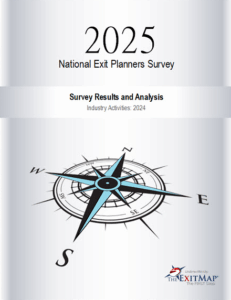
Between February 1 and March 2, 2025, ExitMap conducted its 5th annual survey of professionals who help business owners plan successful exits. This is the only survey that gathers insight across multiple advisory specialties—offering a wide-angle view of the professionals supporting entrepreneurs like you during one of the most critical transitions of your life.

The survey included 30 questions and was distributed to over 7,000 experienced advisors worldwide. These are professionals with recognized credentials in exit planning, active roles in professional organizations, or who publicly position themselves as specialists in business transition. We received 434 responses from advisors in eight disciplines, representing six countries and 47 U.S. states, resulting in a 99% confidence level and a margin of error of 3.6%. Statistically, the results offer a strong picture of the current state of the exit planning landscape.

What Does This Mean for You as a Business Owner?

Exit planning is no longer something only for ageing Baby Boomers. It has evolved into a strategic planning tool for many owners in Generation X and even younger. Whether you’re planning to exit soon or simply want to be ready for future opportunities, exit planning helps maximize business value and align your business with personal and financial goals.

Since the pandemic, the number of advisors in this field has grown by 70%, with a 23% increase just last year. That expansion reflects increasing demand—but surprisingly, most advisors say they’re busier than ever. In 2024, 88% reported as many or more planning engagements compared to the previous year.

What Are Exit Planning Advisors Saying?

    •70% charge separate fees for exit planning services—this work is specialized and structured.

    •96% say exit planning leads to additional support for their clients—like tax strategy, estate planning, and business improvement.

    •57% expect to earn over $50,000 this year from exit-related work.

    •69% focus on companies valued under $3 million, making their services accessible to smaller businesses.

    •80% work with clients remotely, so location isn’t a barrier.

    •Over half are 55+ years old, indicating deep professional experience.

Why an Advisor is Essential in Your Exit Strategy

If you’re like most owners, your business is your largest and least liquid asset. The emotional and financial stakes are high when you’re preparing to exit. The growing network of experienced advisors is ready to guide you through this complex process—helping you make informed decisions, increase business value, and ensure that your exit supports your long-term personal and financial goals.

Planning early gives you more strategic options. Unfortunately, many owners delay until a transition is urgent, reducing flexibility and potential outcomes. Advisors also report challenges in coordinating across specialties and maintaining long-term planning engagement, reinforcing how valuable a committed, collaborative advisor can be throughout the journey.

Bottom Line

The transition of Baby Boomer-owned businesses—estimated at $10 to $17 trillion in assets—is driving rapid growth in exit planning. Many of these are family-run or bootstrapped businesses that have grown into significant mid-market companies. Exiting these businesses often requires a team: financial planners, CPAs, attorneys, brokers, bankers, and more.

As the field grows, so does the availability of structured planning tools like those from ExitMap, which advisors use to help owners like you take the first step. If a future transition is anywhere on your horizon, the time to start planning is now—and the first move is finding an experienced advisor to help you do it right.

John F. Dini develops transition and succession strategies that allow business owners to exit their companies on their own schedule, with the proceeds they seek and complete control over the process. He takes a coaching approach to client engagements, focusing on helping owners of companies with $1M to $250M in revenue achieve both their desired lifestyles and legacies.

The Exit Planning Fallacy – A Business Owner’s Perspective

 
One of the most common sales pitches you might hear from someone claiming to help you “enhance value” goes something like this:

“I’ve reviewed your company and believe it’s worth $4.2 million today. With the right planning, it could be worth $7.7 million. Would you rather exit with $4.2 million or $7.7 million?”

That’s not really a question—it’s a setup. Of course, no business owner would willingly choose the smaller number. But the real issue isn’t which number you prefer. It’s what it actually takes to bridge that gap—and whether you’re being given a full picture.

Are You Falling for the Planning Fallacy?


There’s a psychological term for this overly optimistic way of thinking: the planning fallacy.

A private equity investors group I follow, Chenmark.com, once cited a study published in the Journal of Personality and Social Psychology that perfectly illustrates the concept:

From a psychological perspective, the planning fallacy can perhaps be studied most profitably at the level of daily activities. Consider one familiar example: Academics who carry home a stuffed briefcase full of work on Fridays, fully intending to complete every task, are often aware that they have never gone beyond the first one or two jobs on any previous weekend.

The intriguing aspect of this phenomenon is the ability of people to hold two seemingly contradictory beliefs: Although aware that most of their previous predictions were overly optimistic, they believe that their current forecasts are realistic. It seems that people can know the past and still be doomed to repeat it.

What’s fascinating is that they know this pattern. Yet, every weekend, they’re sure this time will be different. Business owners do something similar: despite knowing how long things usually take (and how unpredictable growth can be), we still believe “this time” will follow our best-case forecast.

You may hear that big valuation potential and think, “Yes, that’s what I’ve always wanted—to grow the company by 83%! I just needed a plan.”

But a plan alone isn’t enough. It’s a start—but not the whole story.

What Really Closes the Gap?


Let’s reframe that optimistic pitch with a more realistic one:

“To grow from $4.2 million to $7.7 million in five years, you’ll need proper planning, dedicated effort, some strategic hires, and reinvesting a significant portion of your profits. That requires growing the business 19% annually—starting immediately. That’s more than double your best year to date. If you spend a year building that foundation first, then you’d need to grow at least 25% annually over the next four years. If you keep growing at your best year’s rate of 7.5%, it will take over 12 years to reach that goal.”

Those are the facts. And the reality is that very few business owners hit those growth rates without serious changes—and trusted advisors to help them.

The Power of Perspective (and the Right Guide)


You may have a solid company. It supports your lifestyle, your employees, and your reputation. Maybe you’ve even dreamed of taking it further. But the risks, the effort, or the lack of a clear roadmap have held you back.

That’s exactly where experienced advisors come in—not to promise easy gains, but to help you map a realistic path to your goals. They help align what you want (your proceeds), with what you’re willing to do (your effort), in the time you have left (your exit timeline).

In our work, we use a Value Gap coaching model that considers four essential pieces:

1. Current business value
2. Your desired outcome—not just “more,” but a specific number
3. The timeframe in which you want to exit
4. The required growth rate to get there

Often, once those last two are on the table, the conversation changes. It’s not just about the money—it’s about what you’re willing and able to do to get there.

The real planning fallacy? Believing it’s just about hitting a number. The truth is, getting the outcome you want depends on understanding the full picture—and working with an advisor who helps you navigate it honestly, strategically, and with clarity.

John F. Dini develops transition and succession strategies that allow business owners to exit their companies on their own schedule, with the proceeds they seek and complete control over the process. He takes a coaching approach to client engagements, focusing on helping owners of companies with $1M to $250M in revenue achieve both their desired lifestyles and legacies.

Build a Successful Business Exit Plan by Using a Planning Process

 
As a business owner, planning the exit from ownership of your business is probably the single most important decision you will make. When to exit, how much to walk away with, who to sell it to, what’s the most tax efficient strategy in your circumstance, what timeline is most suitable, and what are the areas of business that need to be improved upon to make it marketable, etc.? Those are just some of the things that need to be considered.

The challenge for many business owners is they don’t want to think about it until they’re absolutely ready to exit. The problem with that is, you won’t know when that will be, and it may happen unexpectedly, due to health and so forth. Furthermore, and especially with “baby boomer” owners, their business is everything to them – They don’t want to think about letting go, so they put it off. Plus, even if they do sell, what are they going to do when running their business isn’t with them every day. – What’s going to be their purpose when that comes to an end? So, they put it off, and when they decide to exit, the business may be unprepared to sell, the market may not be favorable, or they won’t get the price that they thought they would.

All of what I just mentioned, can be addressed or avoided with the proper business exit plan. A proper business exit plan should be done by applying an organized process. It is also important to remember that building a solid exit plan takes time. It’s nothing that you simply flip a switch, and presto, you have a solid exit plan. There are many things to consider, advisors you need to bring in the mix, data that needs to be collected, and analysis that needs to be performed.

Over the years in consulting my business owner clients, I have developed a “business exit planning process.” The diagram below is an illustration of that process. It breaks the process into three separate phases: “Create A Game Plan”, “Plan Development”, and “Implementation.”
 

The “Create a Game Plan” phase is the initial phase of the exit planning process. This includes completing an exit plan assessment, which determines what areas you will need to address in order of priority, determining your vision for the future (after you have exited), how much you will need to walk away with, whether to sell to a third party or an insider, performing a preliminary valuation, and assembling your team of advisors.

For performing an exit plan assessment, I use a tool called “ExitMap”, which is a handy tool and takes the client 15 to 20 minutes to complete. Determining your vision for your future, is a discussion of the owner’s life after the business. That is an important discussion and may be a transition that needs to be planned for over a period of time. “Letting go” doesn’t come easy for some business owners. In fact, there are even tests now that can help determine how you will handle it when that time comes, and what to do about it. There is a consultant firm in Southern California, by the name of “Orange Kiwi” that specializes in that type of consulting. Determining how much you need to “walk away with”, involves analyzing how much you will need to live your life after the business and the goals you want to accomplish that require financial resources, and how much you have accumulated outside of the business. This will determine the dollar amount that you will need to walk away with, from the business. This is then compared to the preliminary valuation which reveals the “gap”. For instance, if you need to walk away with $3 – $5 million net after expenses and taxes, and your business is currently worth approximately $2 million, then the “gap” is $1 million to $3 million.

This leads us to performing a “preliminary valuation”, which is an informal valuation and costs a fraction of a formal valuation. It is a necessary step in order to determine where you stand and how much of a financial gap exists. Finally, the last step in this phase, is forming your team of advisors. Exit planning is a team sport, and you need the right people/advisors on your team – Professionals who are experienced and who are willing to work together. The diagram below shows a number of potential advisors, an owner may need a few of them or many of them at different times.


The “Plan Development” phase includes the gathering of data, the development of a draft plan, the development of a final draft plan, and establishing a plan of action which includes setting time tables, delegating tasks to advisors, and so forth. When we gather data, there are many areas to gather from. This includes the financials, performing a 5-year cash flow analysis, a 5-year cash flow projection and a host of other metrics, client base analysis, re- occurring income, etc. The draft plan is a starting point of a plan. It is reviewed by all of the participating advisors, which may include the C.P.A., the business broker or investment banker, the out-sourced C.F.O., estate planning attorney, tax attorney or business attorney, and so on. Depending on your particular situation, some or many of these advisors may be included.

The “Implementation phase” of the planning process includes “managing the action steps”, and revising the plan as needed, performing a formal business valuation (one that holds up in the negotiation of the sale), positioning the company for sale or inside transition, and the liquidity event, or the actual sale.

Managing the action steps is critical, because plan execution is critical. It’s one thing to develop a plan, but implementing it properly is crucial in a successful outcome. The exit planning professional can help an owner with that, so that he or she does not get consumed by it and can continue to work on the business. Performing a final valuation is required, which is a solid valuation to include in the sale of the company and also for tax purposes. Positioning the company for sale is where a business broker or a merger & acquisition professional comes in. They are the ones who will position the company for sale, put the company to market, and help to finalize a sale. It’s better if they are included earlier on.

It is also where the implementation of structuring the company ownership comes in. Meaning, what is the best way to position the ownership of the company to achieve the most tax efficient transaction. For instance, utilizing special trusts that avoid state taxes upon the sale of the company. But, that is for a future discussion.

Then comes the liquidity event or the actual sale of the business. It often doesn’t come easy and negotiating with a third party can be grueling and time consuming. But the better you have planned and prepared, the better the outcomes will most likely be.

My intention of this article is to point out a few things: One, the best way to develop an exit plan is by applying a process. Two, exit planning takes time. Three, exit planning is a team sport and requires the careful selection of advisors. And four, exit planning is a serious subject and requires a thorough discussion – more than a discussion with your local C.P.A., although a C.P.A. is a critical advisor in the exit planning process.

Steven Zeller is a Certified Business Exit Planner, Certified Financial Planner, Accredited Investment Fiduciary, and Co-Founder and President of Zeller Kern Wealth Advisors. He advises business owners with developing exit plans, increasing business value, employee retention, executive bonus plans, etc. He can be reached at szeller@zellerkern.com

Purpose – Life After the Sale Part 3


The third component of life after the sale is Purpose – “Having as one’s intention or objective.”

Many exit planning advisors discuss the three legs of the exit planning stool – business readiness, financial readiness, and personal readiness. In our previous two articles, we focused on two of the “big three” components of a successful life after the sale, activity and identity. The third is purpose.

So many advisors point to the 75% of former owners who “profoundly regret” their transition, and say it’s because they didn’t make enough money. To quote Mr. Bernstein in the great film Citizen Kane, “Well, it’s no trick to make a lot of money…if all you want is to make a lot of money.”

I’ve interviewed hundreds of business founders. When asked why they started their companies, by far the most common answers are about providing for their families and having control of their future. Only a very small percentage say “I wanted to make a lot of money.”

Decades of Purpose

Purpose - Life After the Sale Part 3So what kept them working long hours and pushing the envelope after they had reached primary, secondary, and even tertiary financial goals? Sure, non-owners may chalk it up to greed, but Maslov’s hierarchy of needs drifts away from material rewards after the first two levels. Belonging, Self-Esteem and Self-Actualization may all have a financial component, but money isn’t the driver.

For most owners, the driving motivation is this thing they’ve built. The company has a life of its own, but it’s a life they bestowed. They talk about the business’s growing pains and maturity. Owners are acutely aware of the multiplier effect the success of the company has on employees and their families. In a few cases, that multiplier extends to entire towns.

That’s the purpose. To nurture and expand. In so many cases every process in the business was the founder’s creation. He or she picked out the furniture and designed the first logo. This aggregation of people breathes and succeeds on what the owner built.

That’s why so many owners still put in 50 or more hours a week, long after there is any real need for their presence. This thing they created is their purpose.

Life After the Sale

Unsurprisingly, so many owners find that 36 holes of golf each week, or 54, or 72, still isn’t enough to feel fulfilled. You can get incrementally better, but it doesn’t really affect anyone but you. Building a beautiful table or catching a trophy fish brings pride and some sense of accomplishment. Still, it never matches the feeling of creating something that impacts dozens, scores, or hundreds of other human beings.

That’s why we focus on purpose as the third leg of the personal vision. In the vast majority of cases, it involves impacting other people. Any owner spent a career learning how to teach and lead. Keeping those skills fresh and growing is a substantial part of the road to satisfaction.

Purpose in your life after the sale may involve church or a community service organization. It could be serving on a Board of Directors or consulting for other business owners. It might be writing or speaking. Purpose doesn’t require a 50-hour week, but it does require some level of commitment, and the ability to affect the lives of others.

John F. Dini develops transition and succession strategies that allow business owners to exit their companies on their own schedule, with the proceeds they seek and complete control over the process. He takes a coaching approach to client engagements, focusing on helping owners of companies with $1M to $250M in revenue achieve both their desired lifestyles and legacies.

Private Equity Reputation

 
We began this series by saying that Private Equity reputation is as the Great Satan to some, and a savior to others, depending on the personal experience of the speakers. In fact, both reputations are well deserved, but neither can be universally applied.

The “Great Satan” Private Equity Reputation


Man with a net chasing a gold coin walking on legsPEGs buy companies for the express purpose of improving their performance. That often comes with considerable pain for employees. A Searchfunder I know said recently “I’m looking at this acquisition because the owner thinks he is running an efficient company, where I see at least ten points that could be dropping to the bottom line.”

Efficiency is good, but too often it flies in the face of what made a company successful. In one example I recall, the PEG principals spoke to the assembled employees the day after closing on the business. They said “We bought this company for its culture and its people. Those are the most important assets to us.”

The cuts started coming the following Monday. Thanksgiving turkeys were “outdated.” Gone. All bonuses would be performance-based, so extra bonuses at Christmas would be discontinued. Season seats for the local sports franchise – gone. (Most of those went to customers.) Weekend overtime – gone. Schedules would be rearranged so that weekend workers were now scheduled for Saturdays and Sundays and got fewer hours during the week to make up for it.

Employee discounts on the company’s products – gone. Partial subsidies for family health insurance, well by now you are getting the gist. The flood of cuts was shocking and seemed unending. The flood of resignations started soon after.

By the way, the PEG missed its planned flip date (when they were supposed to sell to a bigger PEG) because of poor results and eventually took the company into Chapter 11.
I wish I could say that this type of result was unique, but it happens in far too many cases.

The “Savior” Private Equity Reputation


There is another reality. About 50% of all the privately held employers in the United States are Baby Boomers. The youngest of these are now turning 60. Many have built substantial enterprises whose value is far beyond what a younger entrepreneur can afford.

Private Equity has morphed into a many-headed creature, capable of acquiring almost any size business with value. It will never be for the mom-and-pop businesses that merely earn a living for the owner. As Doug Tatum says in No Man’s Land, they have grown to a level where they provide “wealth” to the owner equivalent to three salaries. Unfortunately, the owner must hold down three jobs for it to work.

But businesses with real cash flow, from a few hundred thousand dollars to a few hundred million, can find a tranche of PEGs who will consider their acquisition. Some specialize in minority ownership, or in funding the transition to a new generation of owners. Like it or not, these will be the saving of an entire generation who became successful by building a illiquid asset.

The latest estimate (from the Exit Planning Institute) is that these owners have $14 trillion dollars locked up in these illiquid assets – their companies. It that was an economy, it would be third in the world behind only the USA and China.

Reputation Counts


Many business owners are dazzled by the money a PEG has. With 17,000 of them out there, “We have money” is no longer as impressive as it once was. If a PEG comes calling, sellers (and their advisors) should carefully research their track record. If they lead with a guy “just like you” who owned a previous acquisition, be cautious. In most cases, he or she is compensated for adding to their portfolio.

Instead, talk to other owners who were acquired previously and are no longer active in the business. Look carefully into the acquirer’s experience in your industry. Unfortunately, “We have money” sometimes dazzles the PEG too. They begin to think financial manipulation is the only thing needed to make any business more successful.

Private Equity reputation is important. It will help you decide whether you should be discussing “show me the money” or “show me the future.”


John F. Dini develops transition and succession strategies that allow business owners to exit their companies on their own schedule, with the proceeds they seek and complete control over the process. He takes a coaching approach to client engagements, focusing on helping owners of companies with $1M to $250M in revenue achieve both their desired lifestyles and legacies.